Director Sarah Gavron brought the radical fight for the vote to the silver screen by balancing historical reality with commercial cinema. London Museum curator Beverley Cook unpacks the controversial tension between archival truth and Hollywood storytelling.
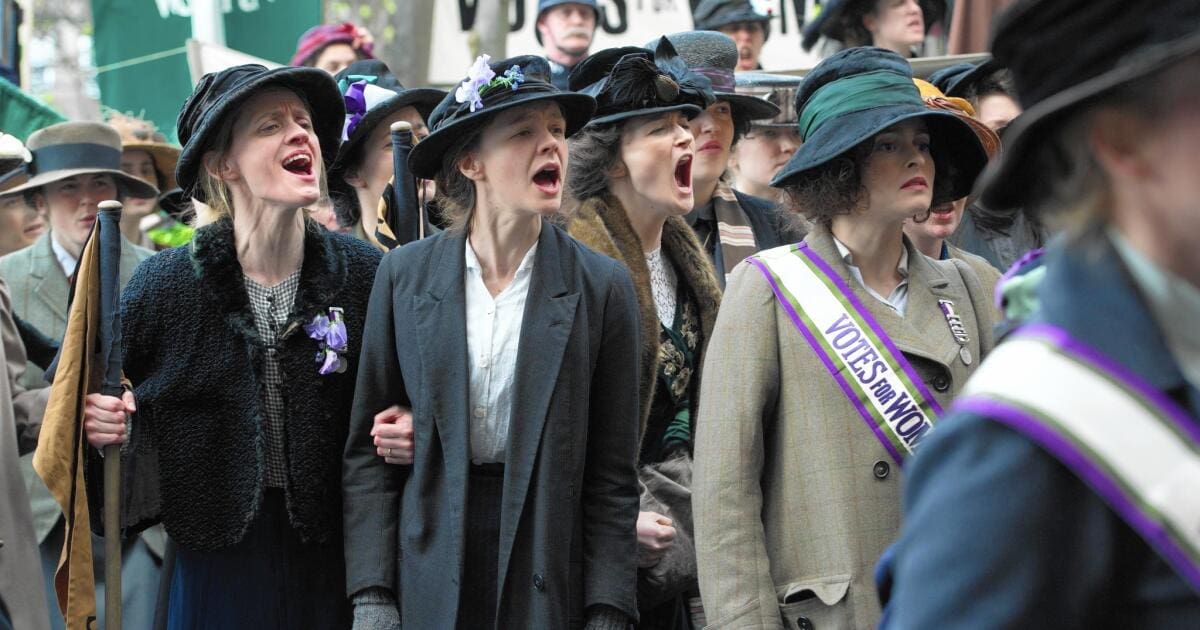
In 2015, director Sarah Gavron and screenwriter Abi Morgan brought the raw, militant fire of Edwardian Britain’s women’s suffrage movement to the silver screen with the feature film ‘Suffragette’. Starring Carey Mulligan, Helena Bonham Carter, and Meryl Streep, this ground-breaking drama bypassed traditional aristocratic narratives to tell a gritty story through the eyes of a fictional working-class laundress, Maud Watts. Arriving over a century after the actual campaign took place, it stood as the first major feature film to fully dramatise the historic struggle. Yet, while the star-studded cast captured the headlines, the true authenticity of the production lay in the background, where a painstaking level of archival research quietly shaped almost every single frame.
The flawless historical texture was anchored by Beverley Cook, a woman who has spent four decades working at the London Museum. For roughly half of that time, Cook has served as the keeper of the world’s largest suffragette collection, safeguarding a deeply personal accumulation of objects ranging from prison letters and handmade banners to hunger strike medals.
“The museum holds the world’s largest collection of material relating to the militant arm or branch of the votes for women campaign,” Cook explains. “It’s a very unique resource, because it’s not really an archive in the traditional sense… there’s a lot of personal stuff.”
When filmmakers first reached out during the project’s earliest development stages, before casting had been finalised, they were captivated by the collection’s sophisticated visual materials. Ultimately, Cook’s archival records proved so vital that the production team built entire sets directly replicating the museum’s historic postcards.
These postcards showed women at work at typewriters and operating printing presses, highlighting a campaign that thoroughly understood the power of branding long before the term existed. The result, when Cook later visited the studio, was striking.
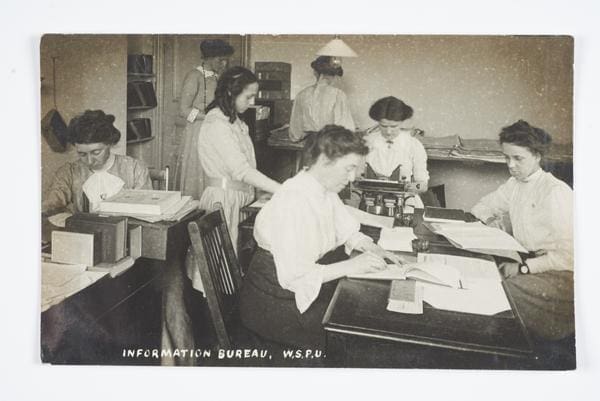
“How they’d really used those images of the offices to build a set that was almost like stepping into one of those postcards,” Cook recalls. “The set was accurate, as accurate as possible. Obviously, the story was fiction. But I was really impressed with the way that they wanted to replicate certain aspects of it.”
Her archive exists not as a cold catalogue of official documents but as an emotional accumulation of private effects. In result of home office and police raids between 1912 and 1914, a massive amount of official paperwork was destroyed. What remains was gathered years later by the Suffragette Fellowship to memorialise their time in Holloway prison.
It was this intense personal reality that drew Carey Mulligan to the museum weeks before filming began. Seeking the authentic detail that would inform her performance, she wanted to truly understand the prison experience and what it actually felt like. Mulligan spent hours huddled in Cook’s office, absorbing the raw, first-hand diaries of women who actually survived in Holloway. Stripped of any cinematic gloss, the unfiltered reality of those accounts left the actress profoundly moved.
When the day came to film the brutal process of force-feeding, Cook was on set witnessing Mulligan’s performance. In a revealing moment that illustrates the delicate balance between historical curatorship and cinematic storytelling, Mulligan requested a closed set and performed the harrowing sequence entirely naked. Cook notes that while this was a dramatic decision Mulligan felt added necessary emotional weight, it was not the actual historical reality of the experience.
“I think she said that she wanted to do it with no clothes on” Cook notes. “I don’t know why she decided to do so as that wasn’t the reality. She just felt that gave it more weight, in terms of emotion and drama.”
It is precisely this tension that Cook sits with thoughtfully. She was present again when a group of consultants, including Helen Pankhurst, great-granddaughter of Emmeline, was invited to appear as extras for the office scene. The experience, despite the questionable costumes, was entirely validating. Cook notes that Gavron and her producers made the historians feel like a genuinely valued part of the process, a rare feeling in media consultancy where experts often feel like mere facilitators.
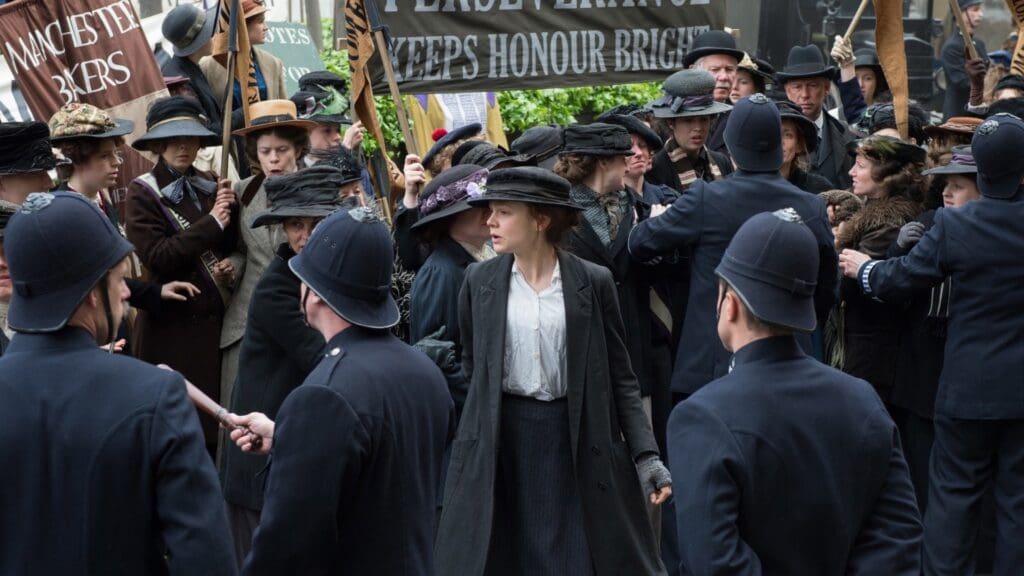
The film was not without controversy, particularly in the United States, where it faced heavy criticism for its near-total absence of women of colour. The visual record of the militant suffragette campaign contains few references to women of colour, but Cook agrees with critics who argued that archival absence should never justify erasure from the screen. It was a legitimate argument that caused a huge controversy, leaving her genuinely sympathetic toward Gavron, who took the brunt of the public criticism.
“In all the images that they had looked at, at the museum, or other places, there are barely any visual references to women of colour,” Cook states. “But the argument on the other side was, just because it’s not there, doesn’t mean to say that gives you the right not to put it in. It caused a huge controversy. I felt really bad for Sarah. She really got it in the neck.”
Cook has spent two decades deliberately broadening the collection beyond its original scope to include the reluctant militants, rather than just the core group who engaged in arson or bombing.
“The woman from Pinner, who smashed a window once, and found herself in prison thinking oh my god, I’ve got a child at home,” Cook says. “They’re the sort of women that actually intrigue me, because I think they’re almost more relatable to most people’s lives. But they’re not as glamorous, no one wants to feature them.”
Ultimately, ‘Suffragette‘ stands as one of the rare major films to take the visual and material history of a movement seriously. Cook knows the bizarre feeling shared by all historians watching their expertise hit the silver screen. The constant and quiet negotiation between the joy of spotting a perfectly accurate detail and a begrudging acceptance of the dramatic shortcuts that cinema demands.
“You have to understand that it’s a Hollywood film, at the end of the day,” she notes, “they have to make it palatable to a wide audience. You’ll always find moments where you think: that isn’t quite right; but as long as they’ve done justice to the emotion, to the people, that’s almost forgivable.”
Almost. Perhaps, the most honest compliment a historian can award cinema.