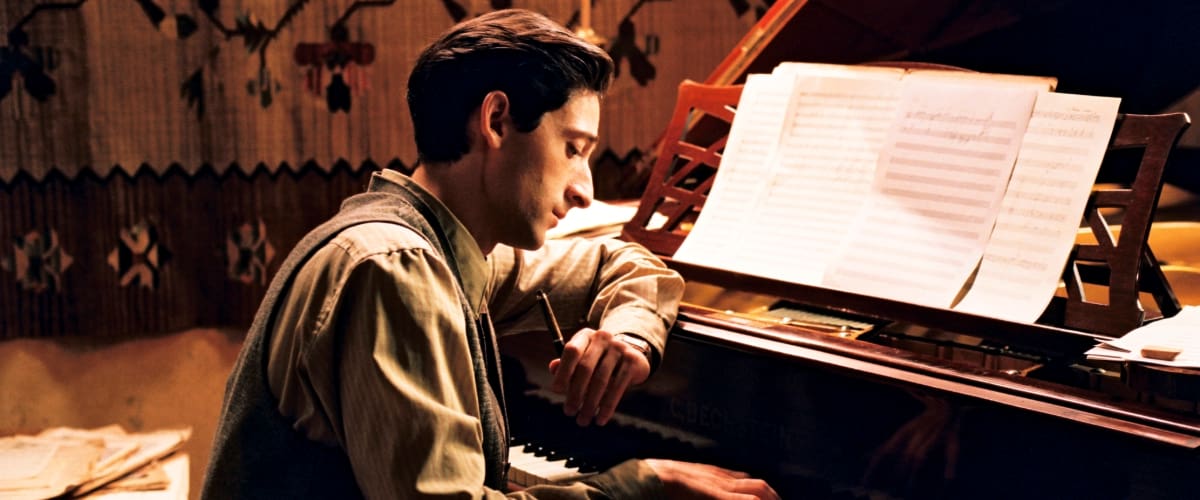
Wladyslaw Szpilman’s story was anything but ordinary; a Polish Jewish pianist evading capture in the Ghettos of Warsaw by sheer will, wit, and immense luck, watching his people ordered to their death at the camps of Treblinka. His parents and his brother were some of these people.
They were packed into cattle cars, and there was nothing he could do about it.
For many survivors, this is a story all too familiar. The film was based on real life experiences, told from the perspective of Adrien Brody, cast to play the man that had lost everything that he possibly could.
Brody’s meticulous method acting included selling his own belongings and isolating himself for weeks on end from public life, to reflect the life of Szpilman in 1940s Warsaw. So it came as no surprise when the film swept up Best Actor, Director and Adapted Screenplay at the Oscars, as well as Best Film at the BAFTAs.
At just 29 years old, Brody also became the youngest performer to win the Academy Award for Best Actor, a record he still holds today.
Histoflick spoke to two experts, Dr Carmen Levick, an expert in heritage studies and holocaust literature, and Professor Annette Insdorf, a renowned film historian and author, to understand the uniquely minimalist tone throughout the film, as well as its historical accuracy.
“The minimalist approach in The Pianist fundamentally influences how the audience experiences the Holocaust on screen,” Levick noted.
“By stripping away conventional cinematic drama, we’re forced out of the role of a detached spectator and into the suffocating, psychological characterisation of a survivor.”
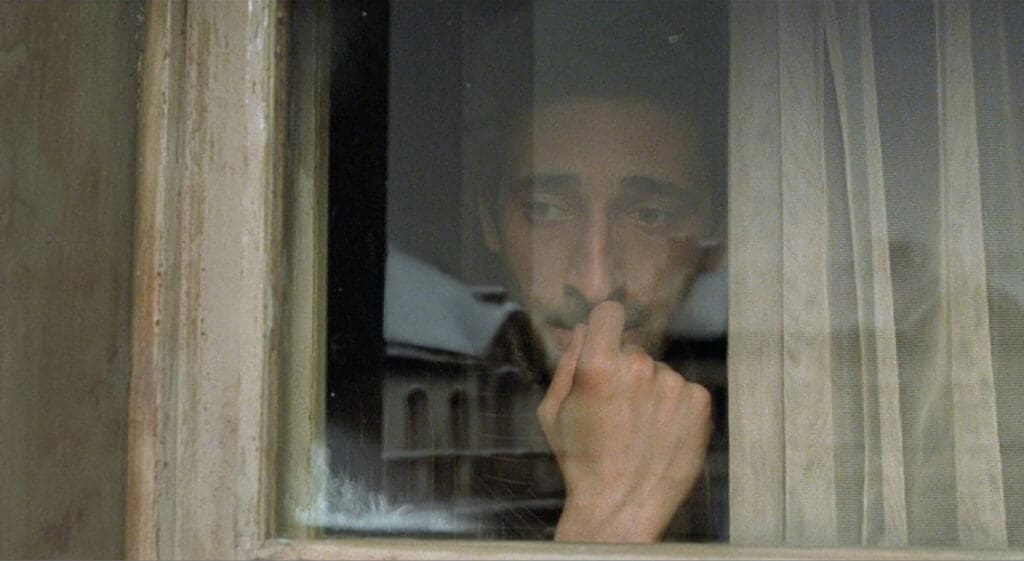
Throughout, the stoic tone of the film is noticeable. Through a minimalist tone, Szpilman’s character is explained not by his words but by his actions, and by his emotions. We’re forced to understand him by the suffocating atmosphere that the film is centred around.
In the second half of the film brief and frantic interactions are all we hear from Adrien Brody, reflective of the profound loneliness that clouded most of Szpilman’s life.
Most of the great Holocaust movies are centralised by psychologically ruthless antagonists; Amon Goth in Schindler’s list, Ralf throughout The Boy In The Striped Pyjamas.
While antagonists do appear in parts throughout the film, with characters such as Heller, a Jewish ghetto police officer who bears resemblance to that of the tyrannical officers in Schindler’s List, The Pianist doesn’t follow the traditional, melodramatic Hollywood characterisations.
“The Pianist is not a traditional drama that follows the protagonist from victimization to heroism. It’s a story of survival – beautifully acted by Adrien Brody–that conveys basic wartime elements of a Jewish victim’s hunger, thirst, isolation and dependence,” said Insdorf.
“In a Polanski film, heroism, always elusive, is a function of survival rather than salvation. He returns to the futility of individual endeavor, as in the famous closing line, “It’s Chinatown, Jake,” she further noted.
Historical accuracy was also of paramount importance for the film, built on the harrowing experiences of racial genocide. Dr Levick considers The Pianist a pillar of Holocaust cinema at its core, and explains why.
“The Pianist is widely regarded by historians and Holocaust survivors as one of the most historically accurate films ever made about the era.
“Its accuracy stems from a rare alignment: it is based directly on Władysław Szpilman’s memoir, written in 1945, right after the events occurred when his memory was painfully fresh.
“Rather than fully relying on fictional narratives, although it contains some fictional elements, the film is meticulous in documenting the process of genocide,” Levick remarked.
Dr Levick further spoke about the film as a representation of a new era of filmmaking, shifting away from a lighter tone that prevailed in many films of the decade beforehand. She believes that this unique tone of the film cements it as one of the greatest pieces of Holocust cinema to date.
“The Pianist represents a shift away from the grand, sentimental, and ultimately comforting narrative arcs of 1990s filmmaking, moving instead toward an era of uncompromising realism and psychological precision. Due to this, the film redefined the genre of Holocaust film by abandoning Hollywood artifice in favour of raw, experiential truth.”
Read our review here.