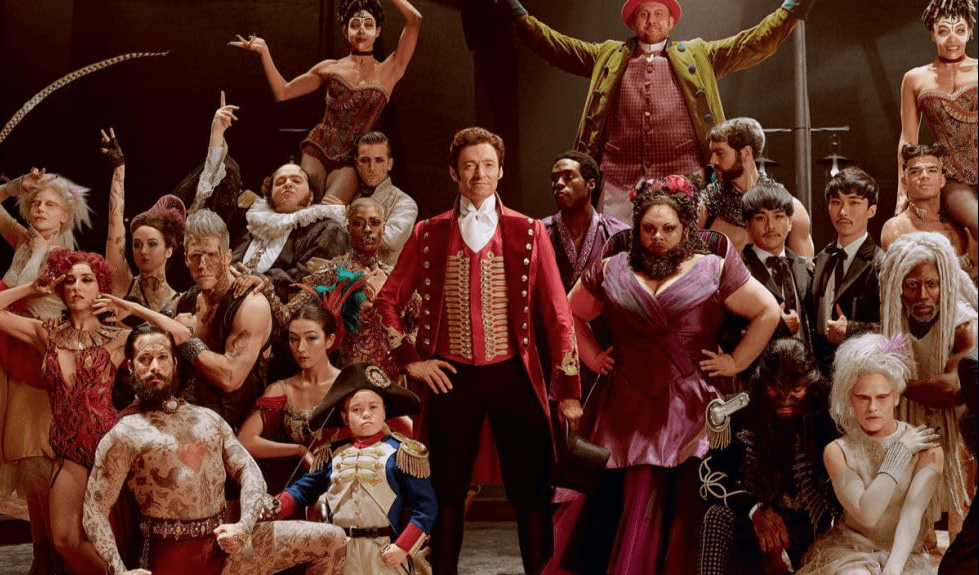
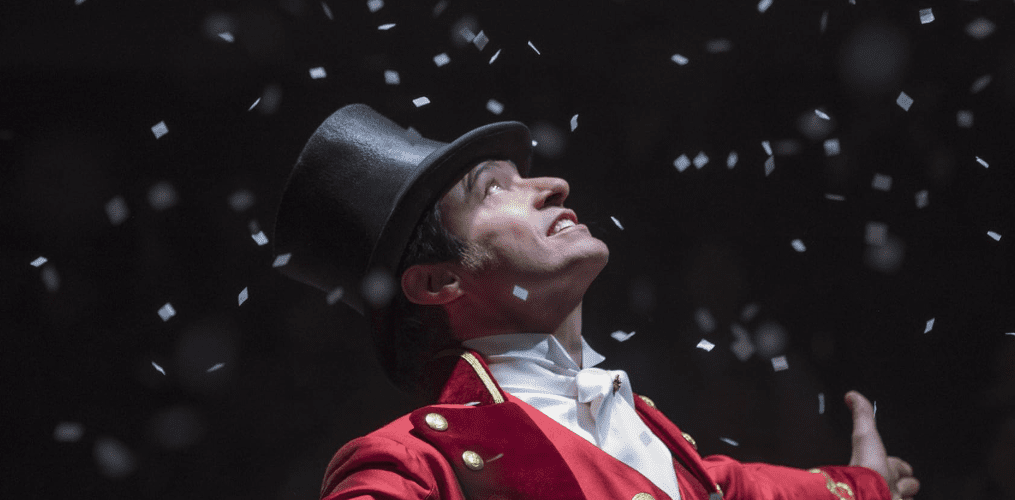
In the opening frames of the 2017 blockbuster The Greatest Showman, a young P.T.
Barnum and his father hustle through the bustling streets of New York City before racing to
catch a commuter train back to Bethel, Connecticut. It is a cinematic, propulsive moment
that establishes the film’s high-octane energy and Barnum’s lifelong drive to move upward
and onward. The scene is quintessential Hollywood: a soaring score, the rhythm of pounding
feet, and the promise of a dream just a rail-ride away.
There’s just one problem: it’s 1820. The commuter train wouldn’t be invented for decades.
“He doesn’t make sense in his own moment in time,” says Kathleen Maher, Executive Director of the Barnum Museum.
“He makes more sense with modern technologies—technologies that simply didn’t exist. He found ways of advancing his dream and his vision that were so far ahead of the curve that the film has to pull from the future just to explain him.”
Cinema has long had a complicated relationship with the truth, often sacrificing the grit of the past for the ‘glimmer’ of the box office. Few films in recent memory have rubbed against the historical record as provocatively as The Greatest Showman.
To some, it is an uplifting anthem of inclusion; to historians, it is a “layer cake” of anachronisms.
But perhaps the film’s greatest irony is that by rewriting Barnum’s life into a neon-lit pop musical, Hollywood accidentally performed the ultimate tribute to the man himself: they gave us a “humbug.”
Fact vs. Fiction: The Temperance King
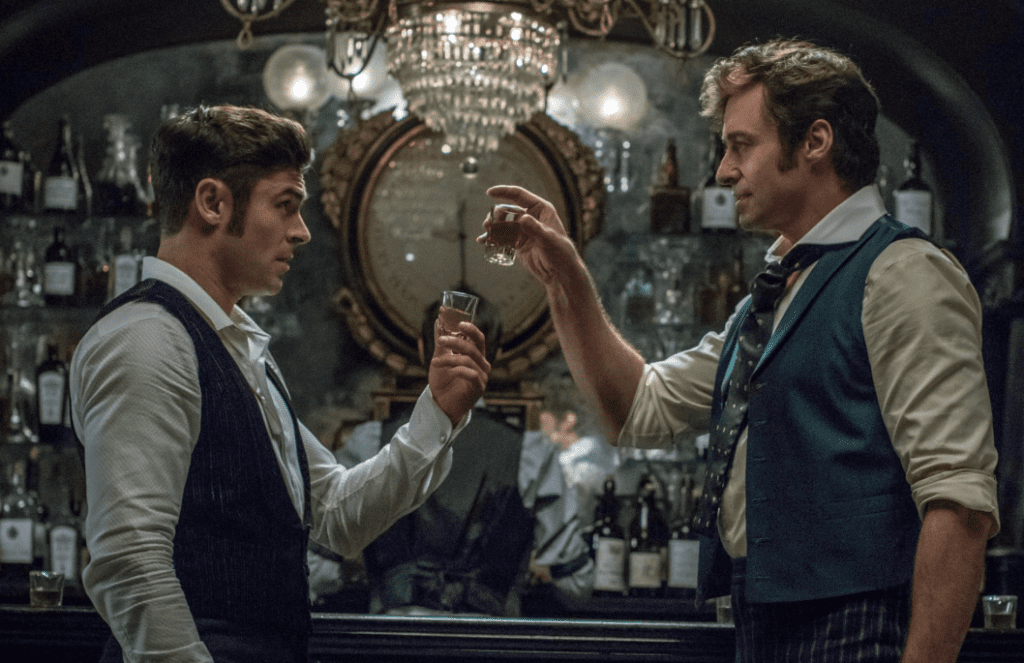
One of the film’s most pivotal scenes features Barnum and playwright Phillip Carlyle (Zac Efron) trading witty barbs and competitive dance moves over shots of whiskey in a rowdy bar.
It’s a classic trope of male bonding, yet the real P.T. Barnum would have been utterly scandalized by the scene.
“Barnum was the country’s leading temperance champion,” Maher explains.
“He completely prohibited drinking and smoking in his museum. If you wanted to drink or smoke, you had to go out and then come back in and pay full price again. He walked the hard line on temperance, moral dramas, and temperance plays.”
Across the street from Barnum’s real-life American Museum stood St. Paul’s Church, a landmark that still exists today.
The idea of Barnum dancing on a bar top in a whiskey-soaked tavern is a direct contradiction of his public and private identity.
Legend has it he even cut the heads off his own wine bottles at home after witnessing the destructive effects of alcohol during his travels.
“He realized he saw civic and business leaders just drunk,” Maher says.
“He said, ‘I can’t accomplish what I want in my life if that’s my behaviour.’ He was clean and sober, a fact that simply doesn’t fit the ‘wild showman’ archetype Hollywood prefers.”
Maher notes that this “sanitization” of Barnum’s lifestyle in the film is ironic because, in reality, Barnum was the one doing the sanitizing.
At a time when theatres were often sites of violence, drinking, and prostitution, Barnum marketed his museum as “Family Entertainment” and “Instructive Entertainment.” He was trying to create a moral, wholesome space in a rough-and-tumble New York City.
The Fan Perspective: Hooked on the Visuals
If the historians are keeping score of the errors, the audience seems happy to ignore them entirely.
To understand why the “humbug” works so well, we spoke to a “superfan” of the film who has watched the movie roughly 15 times. Their perspective highlights the widening gap between historical literacy and cinematic enjoyment.
“Erm, I wouldn’t say so,” the fan says when asked if they now picture the 1800s through the film’s ‘steampunk meets pop’ lens. “I guess I didn’t really think about the era it was set in when watching the film. When I picture the 1800s, I think of less extravagant outfits than the ones in the movie.”
For this viewer, the “based on a true story” label carries little weight. “Based on other movies that are ‘based on a true story,’ I would assume more of it is ‘Hollywood Magic’ over an accurate account of the events,” they explain.
When asked if the revelation that the real Barnum was far more controversial than Jackman’s portrayal would change their feelings, the answer is a firm no. “Not really, as I separate it from the true story and see the film as more of a fictional tale.”
To the fan, the “gift” of the film isn’t a history lesson, but a sensory and emotional experience.
“The dancing in the film is amazing, and the unique choreography makes it interesting to watch,” they say.
“The visuals and music, it has you hooked throughout the whole movie”. This fan’s experience suggests that modern audiences are perfectly capable of enjoying a “humbug” while knowing it isn’t the whole truth.
“I don’t think it would ever be 100% accurate, as it would probably be biased toward the writer… No [it doesn’t need to be accurate to be good], but I get it is important to understand that they aren’t accurate.”
The Power of the “Humbug”
Maher finds a poetic symmetry in this fan’s reaction. Barnum’s own definition of a “humbug” was ‘management and tact’.
“To take an old truth and put it into an attractive form.” This was his secret sauce—the ability to take something mundane and dress it up so beautifully that the audience didn’t care if they were being fooled.
“Interestingly, that’s exactly what the movie did,” Maher says. “They didn’t realize they were doing that, but that was my take on digesting the movie and speaking to it. It’s never been a ‘How dare they?’ for me. It’s a learning moment.”
By taking the “old truth” of Barnum’s life—the story of a man who clawed his way from poverty to global fame—and wrapping it in “attractive” choreography and a modern pop soundtrack, the filmmakers engaged in the very same myth-making that Barnum used to sell tickets to the Fiji Mermaid or Joice Heth.
The fan’s observation that the modern music “appeals more to today’s audience” is something Barnum would have instinctively understood. He wasn’t interested in preserving the past; he was interested in capturing the attention of the present.
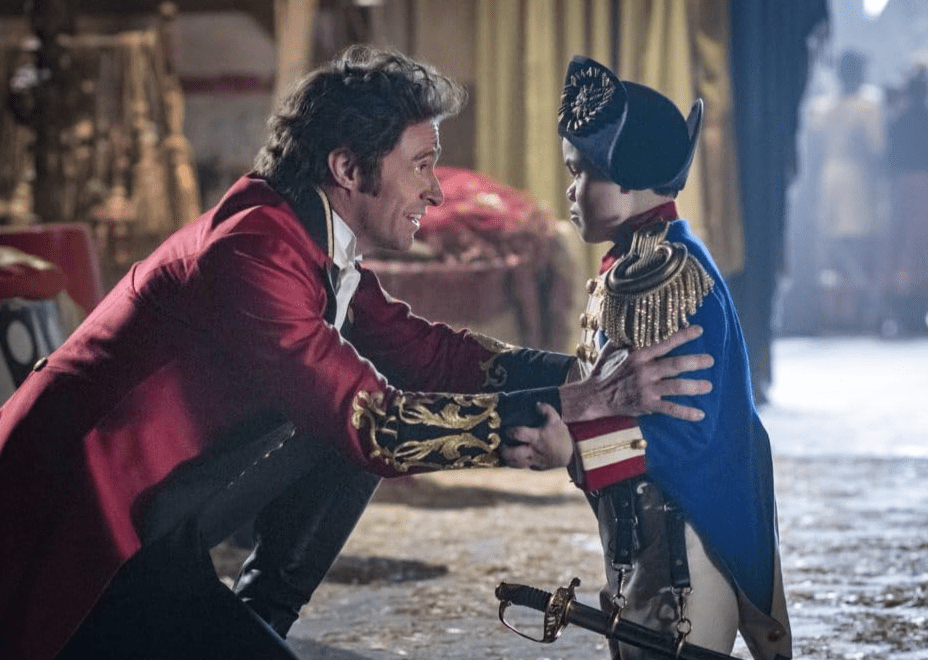
The Museum as the “Right of Reply”
So, what happens when a film becomes the “definitive” version of history for millions of people? For Maher and the Barnum Museum, the release of The Greatest Showman changed the nature of their work overnight.
Instead of fighting the film’s inaccuracies, the museum embraced them as an “entry point.”
“It triggers some critical thinking,” Maher says. “The film becomes the entry point for the conversation. I always use the train example… people leave laughing, and that was the way to do it. Bring people in on the joke.”
The museum’s role has shifted to restoring a legacy that has been flattened. Most people associate Barnum only with the circus—which was actually his “retirement project” launched when he was 61 years old.
They don’t know he was a sophisticated 19th-century innovator who opened his American Museum on New Year’s Day, 1842. Maher works to remind visitors that Barnum died in 1891—28 years before the “Ringling Brothers and Barnum & Bailey” circus as we know it even existed.
“A big challenge we have is that his reputation was tarnished… mostly due to fabricated stories and holding him to a modern benchmark,” Maher explains.
“Often people don’t want to know that he authored the Connecticut amendment to expand citizenship, or donated thousands of dollars to the ASPCA, or was a legislator to ensure all are created equal. Even giving women the vote in a special presidential election in the 1850s! These things don’t fit the ‘evil’ model people sometimes paint him as.”
The Cultural Mirror
Maher, however, believes that the real history is even more inspiring than the Hollywood version. She points to Barnum’s resilience—his museum burned down multiple times, he faced bankruptcy, and he lived through the upheaval of the Civil War.
“We heavily document, and we humanize him within the context of his genre in history… good and bad,” Maher says. “We bring our audiences into an emotional story of struggles and triumphs and peel back the layers of a person with huge dreams, who took risks, won some, lost some, but ultimately found his humanity, faith, and charity.”
Ultimately, The Greatest Showman is not a history of P.T. Barnum. It is a history of how we want to remember our pioneers: as soulful, singing visionaries who just wanted everyone to belong.
The real Barnum—ink-stained, fighting for temperance, and obsessively writing tens of thousands of letters by hand—might be a stranger to us.
But thanks to the film, more people are finally knocking on his museum door to find out who he really was.
In the end, by fooling us into loving a fictional version of his life, Hollywood may have pulled off the greatest Barnum-style humbug of the 21st century.
It took an old truth—that Barnum was an innovator who changed entertainment forever—and put it into an attractive, song-filled form. And somewhere, P.T. Barnum is likely rolling over in his grave—not in anger, but with a wink and a tip of his top hat, recognizing a fellow showman at work.