

Lewis Kennedy meets the sports historians whose definitive research formed the backbone of Disney’s ‘Young Woman and the Sea’ and discovers why Gertrude Ederle’s story is even more extraordinary than the film lets on.
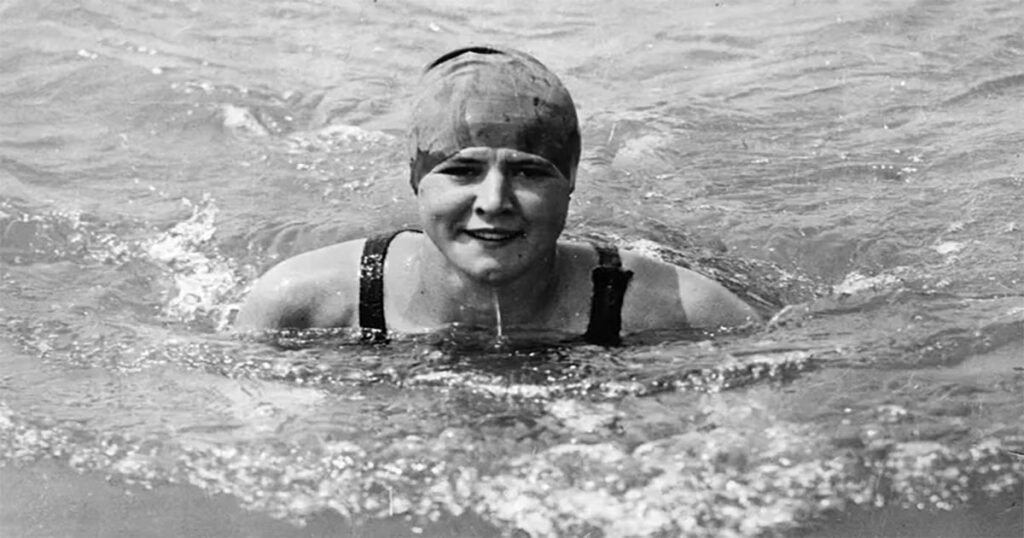
When Gertrude “Trudy” Ederle hauled herself out of the English Channel in 1926, she had not just completed one of the most gruelling swims in history. She had beaten every man’s record by over two and a half hours, proving that the female body was capable of elite physical endurance and sparking a shift that would expand athletic opportunities for women globally.
Disney’s 2015 feature tracks her transformation from a determined Brooklyn teenager into an international icon, but the deeper story of institutional betrayal and a victory that rewrote what women were allowed to be, is even richer than the screen can contain. Sports historian Professor Linda Borish and author Glenn Stout, whose research shaped the very fabric of the adaptation, sat down to reframe this monumental triumph in their own words
The journey of bringing Ederle back into the modern spotlight began with a sense of profound historical mystery for Stout. While reviewing microfilmed newspapers from the 1920s for a separate project, he was stunned to see massive front-page headlines detailing a feat he had never encountered in standard sports anthologies.
“I stumbled across headlines in old microfilmed newspapers and thought, ‘Why haven’t I ever heard of this person?'” Stout recalls. “That intrigued me, and I thought if I was intrigued by it, perhaps others would be too.”
This initial shock motivated him to spend eight years researching Ederle’s life. His work revealed how easily a monumental athletic achievement can be obscured by history. Stout explains that Ederle’s sudden disappearance from public awareness was caused by an unfortunate mix of timing and her own humble personality.
“She didn’t come back to America right away,” Stout explains. “By the time she returned, another woman had swum the channel, so the uniqueness of what she had done was a little bit deflected.”

Furthermore, Stout’s research highlights a distinct contrast between Ederle and other sports icons of the Roaring Twenties. While figures like Babe Ruth aggressively commercialized their images, Ederle harboured a deep distaste for the spotlight.
“She really didn’t like the spotlight, and within a very short period of time, she withdrew,” Stout points out. “It is actually sort of refreshing that she didn’t offer herself out to everybody who wanted to use her for advertising. She just lived a very private life.”
This choice ultimately allowed the public memory to shift toward newer athletes. However, while Ederle was the visible star of this historical moment, Professor Linda Borish emphasises that her platform was built entirely by a brilliant strategist working behind the scenes. In her extensive research into women’s sports history, Borish identified Charlotte “Epi” Epstein as the indispensable architect of American women’s competitive swimming.
“Charlotte Epstein founded the Women’s Swimming Association as an opportunity for young women to have a place to swim, support each other, and swim competitively,” Borish explains, noting that Epstein and Ederle formed a close, lifelong friendship.
Epstein was a fierce administrative powerhouse who spent years navigating an entirely male-dominated sporting bureaucracy. She single-handedly battled the all-male American Olympic Committee to secure competitive entry for women in the 1920 Olympic Games. A central element of Epstein’s advocacy was a radical approach to swimwear reform. Recognising that women could never achieve elite speeds while wearing heavy, waterlogged Victorian attire, she campaigned to eliminate the mandatory requirement for women to swim in stockings.
“Epstein was an early adopter of wanting women to swim without stockings,” Borish notes, “so that they could swim faster and actually help save lives.”
To shift public opinion, Epstein even integrated political activism directly into the sport. Borish describes how the Women’s Swimming Association organised suffrage swim races on the beaches of Long Island. Athletes would race into the surf to rescue heavy lifelike mannequins, a popular press spectacle designed to prove that women possessed the physical stamina to save lives and thus deserved the right to vote. Without Epstein’s leadership, Borish argues, Ederle would have lacked the tools and the societal permission to even attempt a transatlantic crossing.
When Ederle finally set her sights on the English Channel, she encountered a level of institutional hostility that both experts state was remarkably severe. During Ederle’s first official attempt in 1925, her male coach, Jabez Wolffe, forced her out of the water during rough weather despite her protests. Stout uncovers a startling historical truth about this failure, revealing the dark lengths to which men would go to preserve their sporting dominance.
“The record is somewhat unclear, but she believed her entire life that she had been poisoned,” Stout reveals. He explains that Wolffe had profound financial motivations to keep women returning to him for seasonal training. “He knew that if she succeeded, he would probably lose business.”
This profound betrayal completely reshaped Ederle’s strategy for her successful 1926 swim. Borish notes that Ederle returned to the channel with independent newspaper sponsorship and a fiercely unconventional toolkit. Her sister Meg designed a novel two-piece bathing suit, and Ederle slathered her body in a thick layer of grease to insulate against the freezing temperatures and jellyfish.
Stout emphasises the immediate social impact of this victory. “The argument was that women, because of their physical bodies, were not capable of doing things, she blew that notion right out of the water,” he says. It became impossible for politicians to claim women were physically incapable of rigorous labour when a girl had just out-swam every man in history.
The immediate aftermath brought a massive ticker-tape parade, placing Ederle alongside Charles Lindbergh in the cultural stratosphere. Yet, Stout’s historical work tracks a devastating physical toll that followed this triumph. The intense water pressure from her distance swimming permanently destroyed Ederle’s already fragile hearing, leaving her profoundly deaf. This sudden physical isolation, combined with the relentless adulation of the public, resulted in a severe nervous breakdown.
Nevertheless, both experts find inspiration in how Ederle redirected her life.
“What is remarkable is she kept swimming and giving back to the sport,” Borish notes. “She was a swim instructor for youngsters, especially hard of hearing people.”
Borish contrasts this long, fulfilling life with the tragic end of Charlotte Epstein, who courageously boycotted her dream role as an Olympic manager in 1936 to protest the Nazi regime in Berlin, passing away from cancer shortly after in 1938.
Translating this massive historical arc into a feature film required a collaborative process that Stout watched closely. When screenwriter Jeff Nathanson optioned the book rights, Stout warned him that getting a movie greenlit in Hollywood was the perfect metaphor for swimming the English Channel. Projects constantly get close to the shore only to be pushed back by unpredictable industry winds. Stout notes that certain structural changes were mandatory for the economy of a ninety-minute film, such as compressing multiple years of training into a single season and creating composite characters to represent the patriarchal boards of the Amateur Athletic Union.

Ultimately, Stout is incredibly satisfied with the cinematic result, emphasising that the filmmakers successfully captured the emotional core of his historical research. When the producers asked him to identify the single most critical element of Ederle’s success, Stout directed them to the profound bond between Trudy and her sister Meg.
“I told him the core of the story was her relationship with her sister,” Stout recalls. “I think she did a lot of what she did because her sister told her she could.”
By keeping this sisterhood as the anchor of the script, the film honors the real human heart of the story. As Stout and Borish demonstrate, Gertrude Ederle’s legacy was not born out of a desire to be a political pioneer. It was born from a quiet, personal determination to prove her own capability, inadvertently pulling the rest of the world into a new era of equality with every single stroke.
Check Out HistoFlick’s attempt at replicating Trudy’s swim here: https://www.instagram.com/reel/DY68Wa4IDVc/?utm_source=ig_embed&utm_campaign=loading