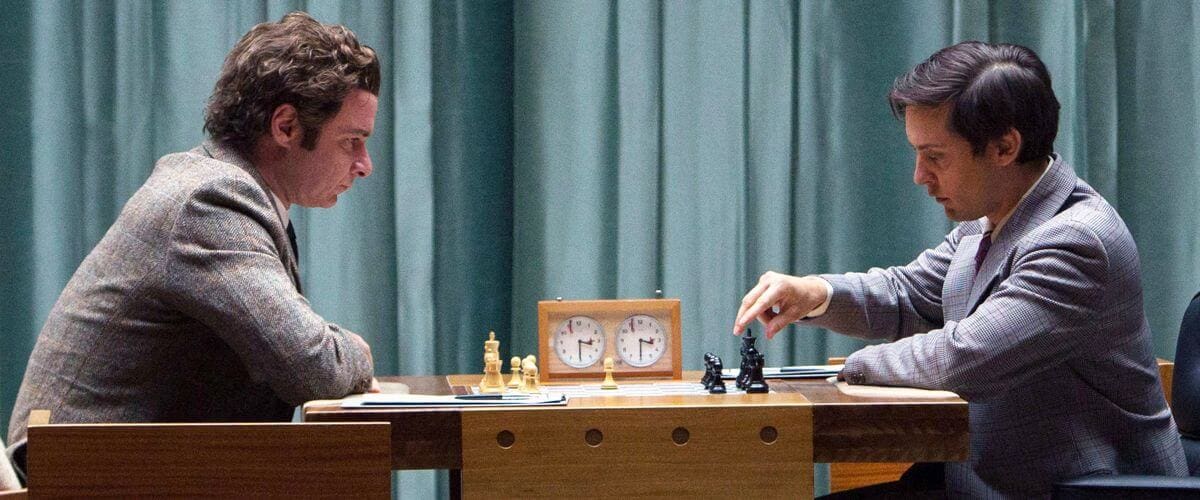
For generations, chess had been the Soviets’ game, a symbol of strategy and intellect that the US simply couldn’t attain. This wasn’t until Bobby Fischer’s American Dream style took offence to the Eastern reign and defeated Boris Spassky at the 1972 World Chess Championship. Matt Stanger explores how geopolitically explosive the moment was in the Cold War, and whether 2014’s Pawn Sacrifice represented what truly happened.
After Bobby Fischer won Game 6 in the final of the World Chess Championship in 1972, applause did not come from the crowd as one would expect, but from his opponent, Boris Spassky. It’s considered one of the most important passages of chess history.
It was a sign of respect towards one of the greatest players to play the game, but also a fascinating plaudit from a Soviet player facing intense pressure from a geopolitically conscious KGB, who didn’t even trust Spassky themselves.
“It’s very difficult to lose at chess,” explains David Edmonds, philosopher and co-author of Bobby Fischer Goes to War. “Often after a game, the losing player just can’t talk for a bit, it’s because you’ve been defeated intellectually, which is much tougher than being defeated physically; it is something to do with the ego. I think it says a lot of good things about Spassky that he was able to acknowledge the aesthetic quality, the beauty of the game, and the power of Fischer’s play to stand and applaud.”
However the magnitude of this moment and the whole match in fact, went beyond the 64 black and white squares of a chessboard and into the Cold War.
Historically, the Soviet Union had always used chess as a propaganda weapon, a way to demonstrate that the communist system was superior to the capitalist system. Dominating chess from the end of World War II all the way up to the Cold War, it seemed everything was at ease. But the genius of American prodigy Bobby Fischer was their only threat.
Edmonds says: “They definitely wanted to beat Fischer. And Fischer, for good reasons, always thought that he was at a disadvantage against the Soviet machine. For one thing, the Soviet grandmasters were paid a salary. There was an incredible training system. Bobby Fischer had none of that.”
“He was a lone individual in the capitalist system playing against the Soviet machine.”
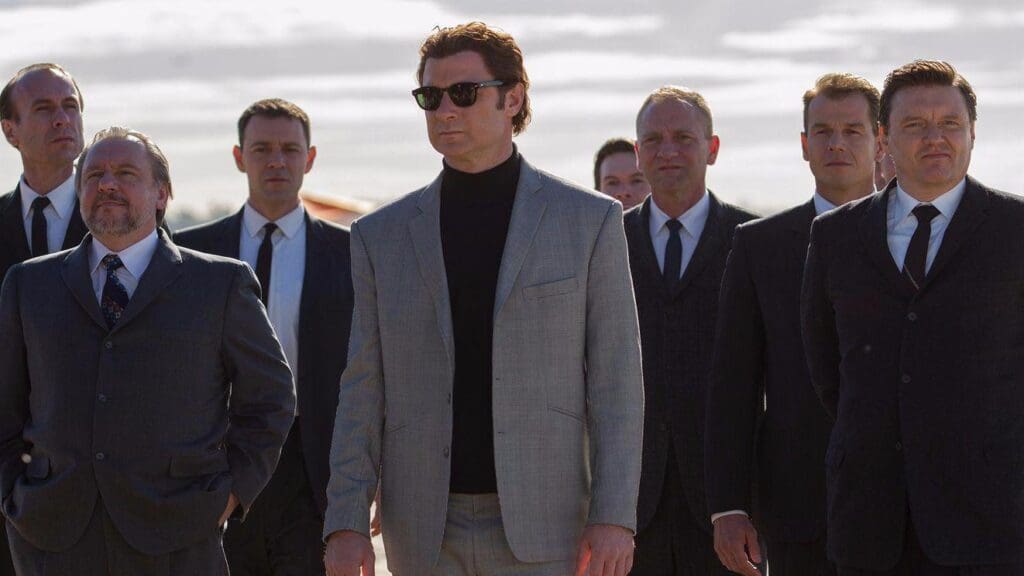
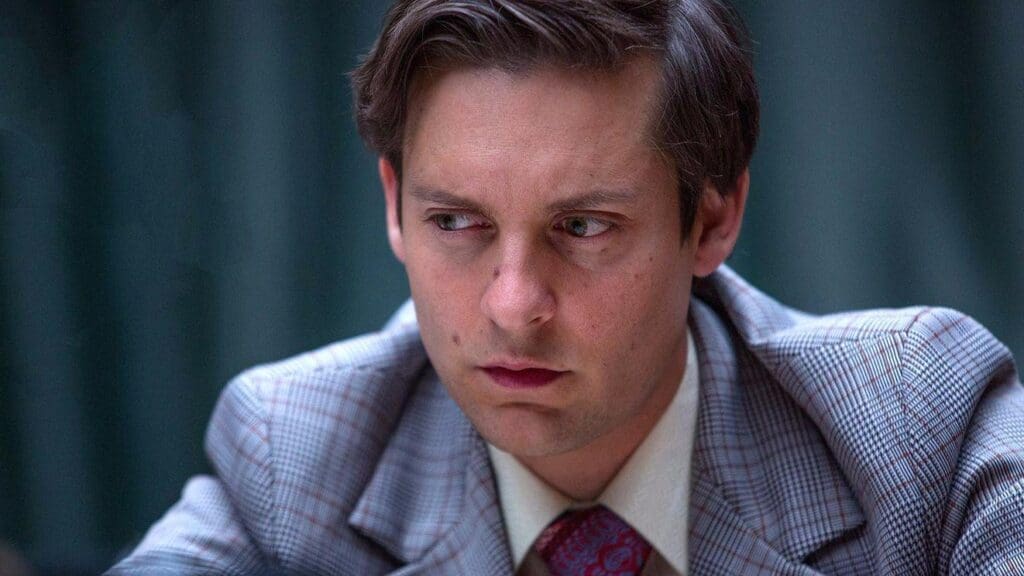
In 2014’s Pawn Sacrifice Bobby Fischer, played by (the usually quite subtle) Tobey Maguire, is very much the antithesis of the Soviet machine and this is dealt with immediately by director Edward Zwick. We first meet Fischer in Reykjavik amidst media reports that he had gone missing for Game 2 of the final. Instead of being present at the game we see him ripping the back of paintings, unscrewing telephones convinced that he is being spied on by the Soviets.
He strips back his cigarette-tinted off-white curtains and a black and white photo is taken.
“Subject: Fischer, Robert James. Case No. 10R-72065.”
Then we cut back to 15. Nov. 1951. An 8-year-old Bobby strips back his curtains once again. Snap. A black and white photo is taken. Across the road Bobby spots a man taking photos not just of him, but his house. He walks to his mother Regina, amidst chattering in Russian and talks of communism throughout the house. He is quick to tell his mother what’s wrong.
Regina leans down and tells her son, “Bobby, you remember what I told you? There are bad people out there that wanna intimidate us because we represent something very threatening to them, the status quo.” You remember what that is?” Bobby replies, “Revolution.”
It’s clear what narrative is set. Pawn Sacrifice is as much about the proxy war on the chessboard as much as a biopic on Bobby Fischer’s early life.
Beyond these opening scenes, Regina Fischer’s influence seems minimal in the film. In reality, her role was paramount.
Historical consultant for the film and psychobiographer Dr. Joseph Ponterotto, who authored A Psychobiography of Bobby Fischer (which Maguire read to prepare for the role), clarifies this dynamic. Dr. Ponterotto traveled to Fischer’s residences in Iceland and Brooklyn to intimately understand his subject.
“Regina is in a couple scenes and Joan (Bobby’s sister) is in a couple scenes, but they played a much more significant and poignant role in his life,” Dr. Ponterotto explains. “She was a single mom and was being hassled by the FBI because they thought she was a spy because she spoke Russian and lived in the Soviet Union.”
After the Cold War ended it was revealed that the FBI had a 992 page document of information on Regina.
He added: “She lost jobs because the FBI would interview her bosses and then she’d get fired. Regina was always there for Bobby and helped raise money for him because there was no money in the US for chess. Boris Spassky had multiple seconds, in the Soviet Union, chess was like baseball or soccer in England and Brazil. It meant everything to them.”
Therefore with his mother and sister’s influence, chess was where Fischer truly found his identity, and he became obsessed with the game. Winning the US chess championship at 14 and becoming a grandmaster at 15 was evidence that chess was his life, and he would spend up to fifteen hours a day honing his passion.
Dr. Ponterotto said, “It was his moral compass in a way, the lighthouse. Early pictures of Bobby show him playing baseball and things like that. He kind of gave all that up once he found chess. First of all, he loved the game and he had a knack for it.”
“Chess became his friendship network, his social network, his self-esteem because he was awkward even as a kid.”
The Manhattan Chess Club, the Marshall Chess Club, and his coach’s house became sanctuaries. He even learned Russian and Spanish simply to study foreign chess magazines and follow players he admired.
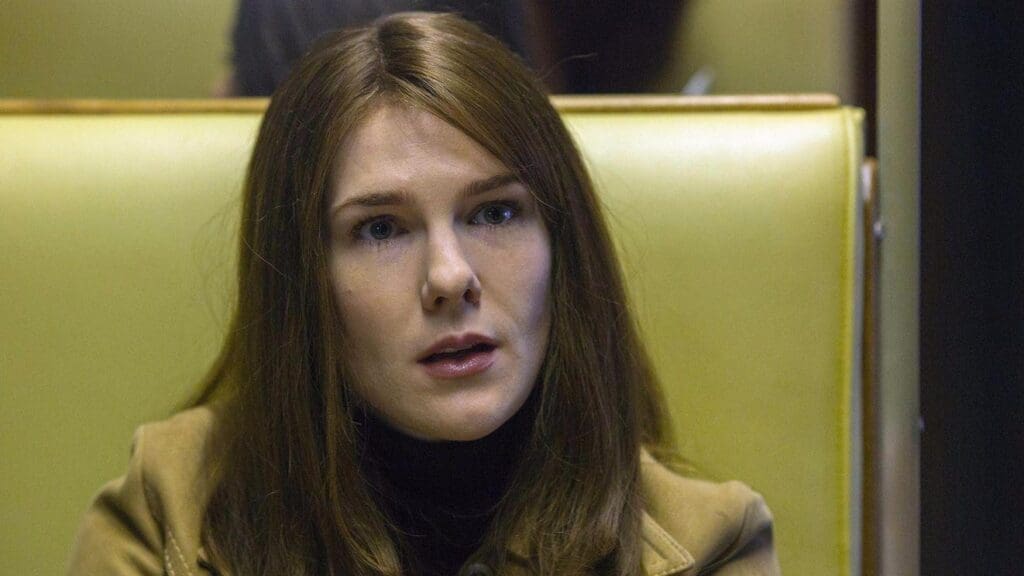
Alongside his undeniable skill, Fischer was psychologically unnerving when he played an opponent, and this is certainly shown in Pawn Sacrifice towards the lead up to the 1972 match. During the 1966 Piatigorsky Cup in Los Angeles we are shown Fischer playing an opponent from the Soviet Union who after the game said, “It was like…Having a building fall on me.”
His coach quickly responds, saying “The team doctor will examine you. You have the flu.” How typical.
Edmonds says, “In chess, many chess players play the opponent, so they understand the opponents weaknesses, they understand for example that they might be less good in the ending than in the middle game. They might engineer a quick exchange in the middle game to get to an ending. They might understand that opponents closed positions rather than open positions. They understand what openings they like. Many chess players will play the opponent and their moves will be informed by their opponent and their opponent’s style.
“Fischer was much more robotic that way. He played the board. What he was interested in was the best objectively move on the board. It felt like you were playing a machine.”
But while his on-board play was flawless, his off-board reality was fraught. Dr. Ponterotto notes that while a modern diagnosis is impossible, Fischer clearly struggled psychologically, evidenced by his erratic demands and extreme sensitivity to his environment.
In the film, Fischer is tormented by flickering lights and coughing crowds. His advisors, Paul Marshall (Michael Stuhlbarg) and William Lombardy (Peter Sarsgaard) faced constant abuse to meet his demands for higher fees or specific chairs.
This culminated during Game 3 of the 1972 final, when Fischer refused to play unless the match was moved to a silent, camera-free back room.
“It was what he needed to do to find his central focus,” says Dr. Ponterotto. “I don’t think he was playing psychological games on Spassky. He was very sensitive to light and noise, his receptor cells picked up everything, which is how you become good at chess too. It may have just been too distracting for him.”
Spassky sportingly agreed to the change in room, but not to the favour of his Soviet team. He was a great sport, and this reflected throughout the match and their lives Spassky and Fischer had great respect for one another.
Whilst Edmonds was interviewing former chess world champion Garry Kasparov, the grandmaster told him something he won’t forget for the rest of his life. “Kasparov said that very few people can compose like Mozart or Mara but everybody can appreciate their music. Chess is not like that. So very few people can play like Fischer or Spassky and almost nobody in the world can appreciate the chess because nobody in the world can understand the depth that they’re thinking of.
“To be an elite chess player, unlike being an elite musician or a tennis player, it’s very lonely because you’re performing in an activity that nobody can understand except for very few people and that might partly explain why Fischer and Spassky have a respect for each other because they understand they’re not many people in the world.”
Despite the appreciation that each other had for the game Bobby Fischer went on to win the World Championship in 1972 and beat Spassky 12.5 points to 8.5, a chess game that is now been dubbed the Match of the Century. Fischer’s rise to glory was unprecedented against the great wall of Soviet dominance, and millions watched across the world as Big Sam checkmated The Union.