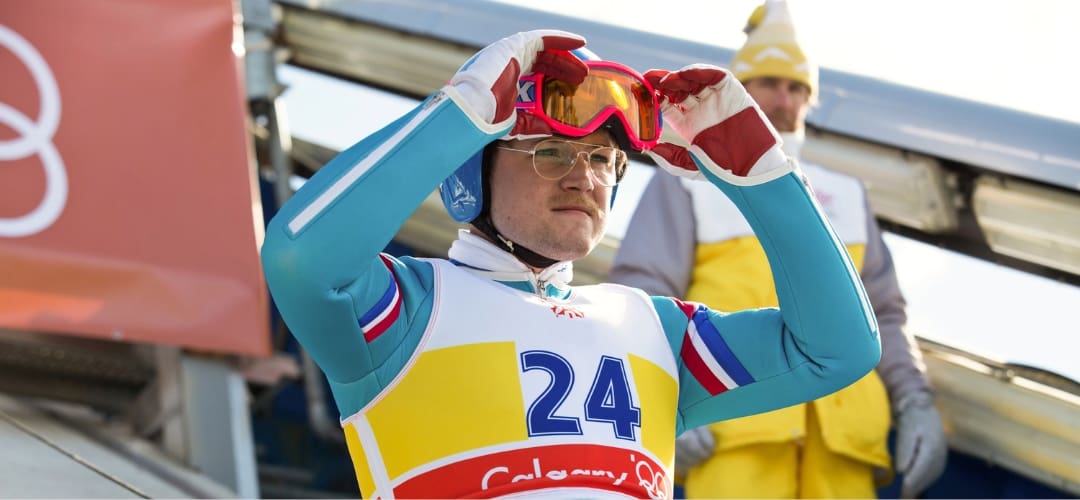
When people think of sporting underdogs, one name that often comes to mind is Michael “Eddie the Eagle” Edwards. The British ski jumper captured the hearts of millions at the 1988 Winter Olympic Games and inspired his own biopic starring Taron Egerton and Hugh Jackman. Now, 10 years since the movie released and 38 years since Calgary, Eddie speaks on the movie and the struggle to even get to the Olympics.
Michael Edwards was always obsessed with sports. But his Olympic dreams date back to when he watched the 1972 Munich Olympic Games aged eight.
“I thought it was really cool to see our athletes, especially British athletes, walking around doing their sport.
“They had Great Britain on their tracksuits, and I thought it was really cool, and I thought, ‘Wow, I’d love to be like that and have Great Britain on my tracksuit and be good enough at my sport to represent my country.’”
He then took up many sports, from team sports like football, cricket and rugby, to racket sports like tennis, squash and badminton, and even martial arts such as Kung-fu, Karate and Judo, but it wasn’t until he was 13 on a school trip that he found his love of skiing.
“Skiing was my first love. I didn’t know we had one of the biggest dry ski slopes in the country just a few miles away, and it all started there, really.
“I did Slalom, Giant Slalom, Super-G, got into the England team, got my racing licence to race for Great Britain Internationally in Slalom and Giant Slalom.
“I loved that, but then I ran out of money.”
It was costing Eddie $300 a day to train for Ski racing at Lake Placid in Upstate New York, compared to $5 a day for Ski Jumping, and that’s when he made the switch.
“That was my equipment: lift passes, trainers. Paying for my trainer every day to come up the mountain and train with us. Ski Jumping was $5 a day, so it was much easier.
“I thought: well, this is cool. It’s still skiing. It’s much cheaper. And then about 6 months later, I realised that Britain never had a ski jumper before, and I thought, well, I’ll see what I can do about it. I progressed up the big Ski Jumps up to the 90m and 120m, and then managed to qualify eventually for Calgary.”
To fund this, Edwards had to work as a handyman, which is how he met his Ski Jump trainer.
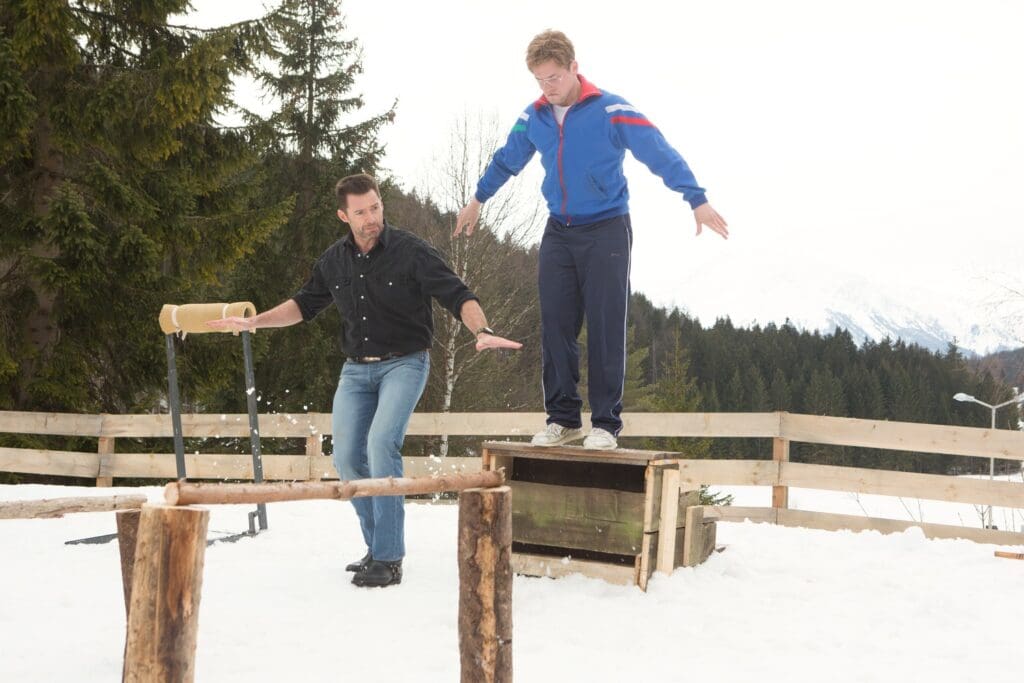
“We used to go round and do odd jobs for people: cutting grass, doing some painting and decorating, and drywalling. I used to go with him, and he would give me some money, which paid for my ski jumping and food.
“The stuff they used in the film was actually quite good. We did a lot of that technique. The Box jumps, the hurdles, sprinting, all that kinda thing. It was much, much tougher in real life than the film portrayed because the film is about 90% true, but it only represents 5% of my life as a skier and as a ski jumper.”
During the time he spent in Europe, Edwards slept in his mum’s car, as well as in cowsheds and barns, while doing odd jobs to get by, but one thing he wished that the movie covered was his time in a psychiatric hospital in Finland.
“I was training with the Finnish team in Kuopio, I met one of the ski jumper trainers, and he was a painter and decorator working in a psychiatric hospital. He managed to get me to stay there for 5 weeks.
“Once I got my letter to say I was going to Calgary, I came to London, picked up my Olympic uniform, and then went on to Calgary.
“That would’ve been fun to put in the film, but they didn’t do that.”
It was at the 1988 Olympics in Calgary where Eddie Edwards’ Olympic dream would come true, where he would jump in front of 82,000 people as well as the millions of people back home. Despite coming 58th out of the 58 ski jumpers present, he felt like he had already won.
“For my family and me, and for everybody, they thought it was absolutely amazing because when I started skiing as a 13-year-old, and I fell in love with the sport, I told all my family and friends that I wanted to go to the Winter Olympics, and they laughed.
“They said it can’t be done, it’s impossible, we don’t even have any snow, and to finally get there and they came out and watched, they never believed that it would ever happen.
“To put that Olympic Tracksuit on for the first time was amazing. It was a dream come true. To be christened “Eddie the Eagle” was a bonus.
“Getting there was my real gold medal, and I was going to enjoy every single second being there.”
Edwards didn’t expect the massive reaction he got from the world.
“I knew that I was going to come 58th, because some of the other jumpers that I could beat didn’t go to Calgary, their countries didn’t send them. So I knew that there would be a bit of a gap between the next guy and me.
“For me, I was hoping to get a little bit of attention from the UK Press and then hopefully turn that attention into sponsorships, and then [it would be] easier for me to go to the 1992, ’94, 2000, 2002 and 2006 Olympics.
“I wanted to show the World what Eddie the Eagle and what Great Britain could have produced in the way of Ski jumping. I didn’t realise that I was going to get christened “Eddie the Eagle” and it exploded.”
Edwards remarked that with a couple of exceptions, the rest of the Ski Jumpers loved the attention that he was bringing to the sport.
“99% of the other jumpers loved it. They were saying that I took the sport of Ski jumping from Page 58 down to page one. All this attention that was being thrust upon me was also being thrust upon the sport of Ski Jumping
“It was really one or two that were saying, ‘I’m the best Ski Jumper in the World, I should be the most popular,’ but the other jumpers would say that it was a great promotion for the sport.”
The authorities didn’t share the same enthusiasm for the newly christened Eddie the Eagle’s popularity. As a result, Michael Edwards joined athletes such as Bill Koch, Wilt Chamberlain, and Kareem Abdul-Jabbar in having rules created because of their impact.
The “Eddie the Eagle rule” meant that you had to be in the top 50 internationally or top 30% in your sport to compete in the Olympics, whichever was fewer. This effectively ended Edward’s Olympic career.
“They couldn’t ban me specifically, but they banned me indirectly by bringing that new rule. At the time, that was impossible for me to do.”
The British Ski Federation also stood in Edwards’ way, instead of the British Olympic Association, as the movie portrayed. Before Calgary, they increased the qualifying jump on four separate occasions, to the point where he didn’t know if he was going to go to the Olympics five weeks before Calgary.
“They said I had to jump over 50m, and I did that. Then they said 55m, and I did that. Now we’re changing it again, we’re going to make it 60m, and they kept doing that.”
The British Ski Federation also refused to send Edwards to the 1998 Nagano Games, despite him reaching the qualifying jump.
“In Calgary, I was averaging about 55m on the small hill and about 70m on the big hill. But when I was training for Nagano in 1998, I was averaging about 90m on the small hill and about 110/115m on the big hill, so I reached the qualification, but the British Ski Federation still turned around and said, ‘Congratulations, but we’re still not sending you to the Olympic Games.’
“I did become a better Ski Jumper, just nobody got to see me.”
When asked about this, Chris Scott: a spokesperson for GB Snowsport, the organisation which replaced the British Ski Federation, said: “GB Snowsport didn’t exist at the time of the Calgary Games, and we wouldn’t be in a position to comment on any of the actions of any earlier organisations.”
“GB Snowsport has well-established and publicly available criteria for athletes across all disciplines – including Ski jumping – and that for any athlete developing towards international competition standard, the criteria for them to be selected to represent the nation are well-established and consistently applied.”
The Eddie the Eagle movie was based on a book that his friend wrote for him a month after Calgary.
“After Calgary, a friend of mine was a sports reporter who also wrote books. I put some of my stories on tape, and then he put them onto paper and put them in decent English for me, and we put out a little book.”
Edwards loved the film and claims that he has seen it 164 times.
“They did a really good job. They really captured the heart, spirit and essence of my story. I couldn’t believe how much Taron Egerton looked and sounded and acted just like I was, and he made the film so easy to watch because he played me so well.”
One person who wasn’t as enthusiastic was his father, who didn’t like how he was portrayed.
“He loved the film, but he didn’t like how he was portrayed.
“Really, he was just like my mum. He only got a bit narky when he wanted me to do some plastering, and I wanted to go off and do my training.”
Edwards’ next adventure is to write another book about his life and career, but include more of the struggles he faced along the way.