Ali Abbasi’s The Apprentice laid bare one of the most revealing chapters of Donald Trump’s past. From Roy Cohn’s mentorship to Trump’s furious public backlash, the film traces how an origin story long dismissed suddenly became politically explosive in the shadow of the 2024 election.
‘Admit nothing, deny everything’. It is hard to ignore the symmetry: one of the key phrases Roy Cohn once drilled into his devoted mentee are the same principles Trump seemed to embrace when confronted with Ali Abbasi’s biopic The Apprentice.
It’s May 2024, and the film has just premiered at the Cannes Film Festival for the first time. Days later Steven Cheung, (Trump’s campaign communications director) speaking to Variety said: “This ‘film’ is pure malicious defamation, should not see the light of day, and doesn’t even deserve a place in the straight-to-DVD section of a bargain bin at a soon-to-be-closed discount movie store, it belongs in a dumpster fire.”
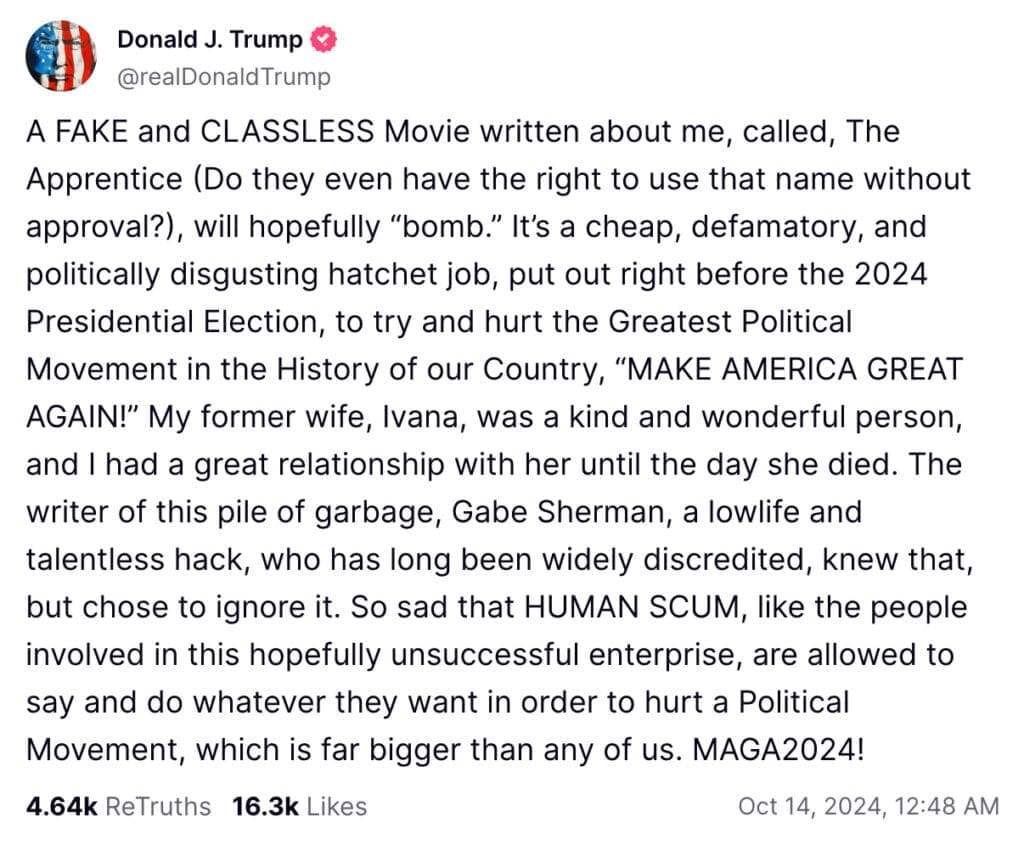
Fast forward to October 2024, and the presidential candidacy is about to take place. On his social media enterprise ‘TruthSocial’, the President condemns the film as ‘A cheap, defamatory, and politically disgusting hatchet job’, personally targeting screenwriter and Vanity Fair journalist Gabe Sherman as a ‘lowlife and talentless hack’. Clearly, Mr Trump believed that the film could be a threat to his presidential wishes. During the London premiere of the film, Sherman told the BBC that he was “happy that he (Trump) is paying attention to the film. It means it’s touching a nerve.”
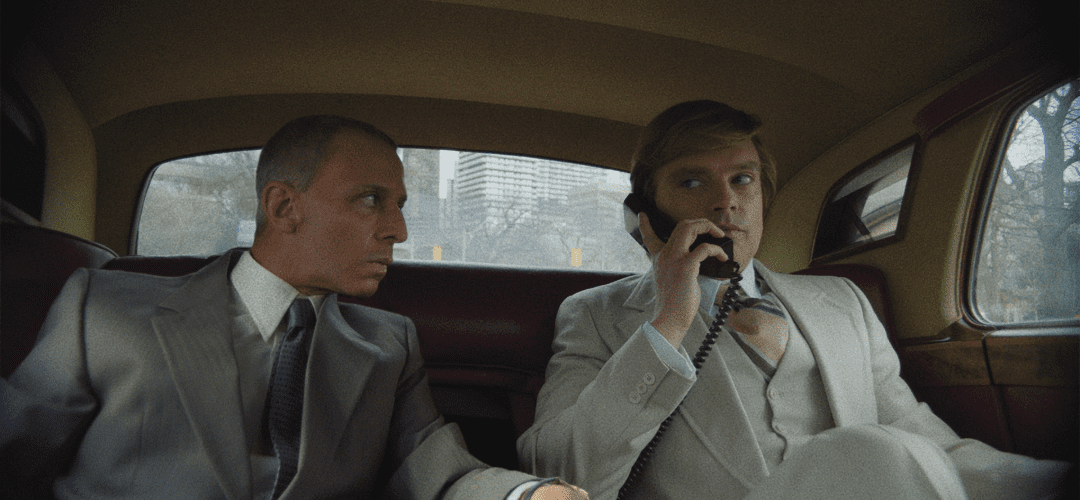
But why was the current president so adamant? The biopic, which explicitly lays out the relationship between him (Sebastian Stan) and Roy Cohn (Jeremy Strong) reveals what had never been visualised before on this scale, and a side of Trump that he might not have been particularly proud of.
From 1973 to 1986 director Ali Abbasi and screenwriter Gabe Sherman explicitly lay out the period in Donald Trump’s life where renowned lawyer Roy Cohn mentors him through his father’s legal battle against the Government, the development of Trump Tower and his courtship of his late wife Ivana.
Nonetheless, we are the testament to Donald plummeting deeper into Cohn’s elitist and morally corrosive circle, providing an early blueprint for the public strategies that persist to this day.
Kai Bird has written numerous biographies on American cultural figures, such as former president Jimmy Carter, lawyer John McCloy and scientist J. Robert Oppenheimer (the latter which was developed into Christopher Nolan’s 2023 biopic).
He says that Cohn “appears in each of these biographies as an annoying pest, a McCarthyite right-wing lawyer who pops up in an annoying but inconsequential way.”
He is now in the process of writing a biography about Cohn called American Scoundrel: Roy Cohn’s Dark Journey From Joe McCarthy to Donald Trump, set to release in September.
Despite Cohn featuring in all of his previous biographies, Bird said: “It suddenly occurred to me that I had made a mistake in my evaluation of Roy and my portrayal of him, in a matter of fact he turns out to be a much more consequential figure than I had realised.
“He’s really emblematic of the dark side, the underbelly of America.”
In post-war America, Cohn rose to prominence in the 1951 espionage trial of Julius and Ethel Rosenberg, and then the chief counsel to Joseph McCarthy and onto representing all five mob families in New York, before moving onto Trump. Bird references him as the “high profile celebrity divorce lawyer.”
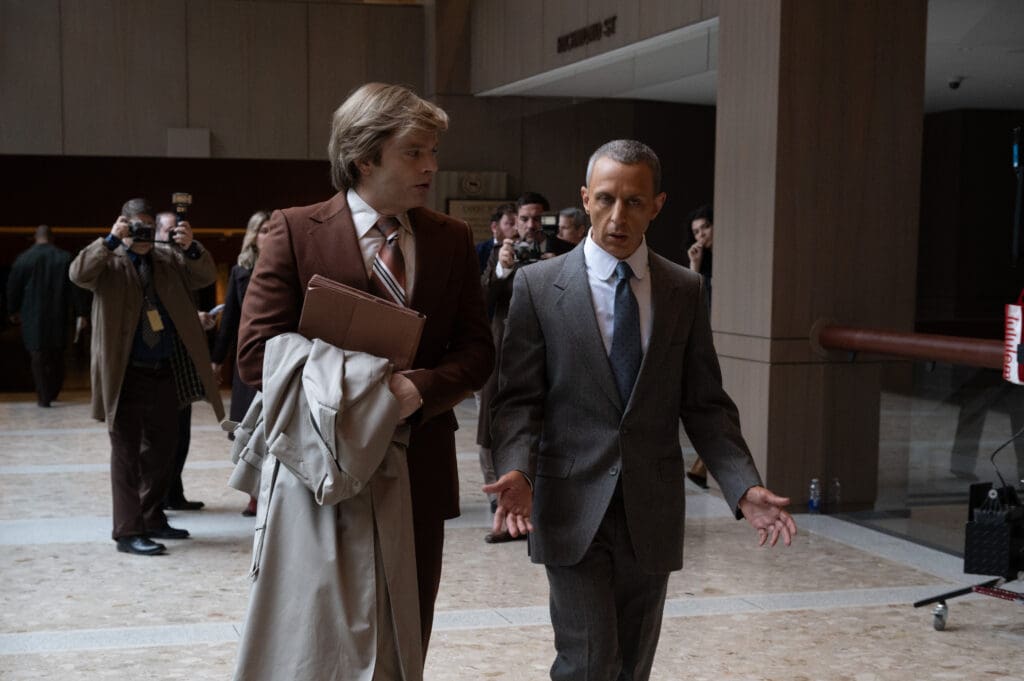
From the moment they first meet in ‘Le Club’, an exclusive private members club (which Donald proudly announces that he’s the youngest member ever admitted), one of the first words uttered by Cohn is emblematic of his character.
“I’m not going to bite.” How appropriate.
Bird said, “The film is very successful in portraying the relationship between Roy and Donald. I have nothing but praise for it. But with any film, there’s going to be some liberties taken.”
Amidst the first legal battle that Cohn is representing Trump, a mere $160 million tax abatement to redevelop the Commodore Hotel, we witness a closet door open, before a room overflowing with a mass of taping machines is revealed.
Bird said: “That didn’t exist. But it is true, on the other hand, that Roy’s longtime switchboard operator (Christine Seymour) sat before an old-fashioned switchboard plugging in wires, taking calls and connecting Roy to people.
Christine was authorised by Roy to listen in on his phone conversations and take notes and we actually have some of those notebooks. He was listening in on some of his clients but that’s different than a taping machine.”
Cohn would do anything to win, and that’s just what he drills into his apprentice.
Number one. ‘Attack. Attack. Attack.’
Number two. ‘Admit nothing, deny everything.’
Number three. ‘No matter what happens, no matter what they say about you, no matter how beaten you are, you claim victory and never admit defeat.’
These three rules are symbolic of the way he articulates himself today, and Bird says you can hear Roy talking through him.
Kenneth Fuchsman has co-edited the book, ‘Psychoanalytic and Historical Perspectives on the Leadership of Donald Trump’, as well as being the President of the International Psychohistorical Association from 2016 to 2020.
He said: “When Roy took him under his wing and became the model for Donald to this day Cohn told Trump, you don’t settle, you up the ante. Trump is still doing that now.
“Outside of his father (Fred Trump) there has been no other person in his life that has had the consistent impact and admiration from Trump for a certain period of time than Roy Cohn.”
Fuchsman has applied many psychological theories to the personality of Donald Trump, one being his mastery of the media.
“In this regard, what first became most evident is during his first divorce with Ivana and they were each telling their side of the stories to different gossip columnists. It was a gossip column war, and so that’s when he sort of found his niche in knowing how to get headlines.”
In the modern day, Fuchsman references points in his political career where this happens.
“Not long before January 6 (2021), he called the Republican Secretary of State in Georgia and told him to find 12,000 votes so that Georgia could be in his column.
“Nothing stops him. In one of the reports on January 6, they document 11 times that Trump is told by some of his officials that certain things he said were not true, and so don’t say them anymore. That didn’t stop him for one minute from repeating the same thing because it’s not what’s accurate that matters.
“It’s how things play.”
From the time that Cohn mentored Trump as his ‘apprentice’, it becomes clear in the film that this is a totally different Donald Trump than what we see today.
Screenwriter Sherman brought light to a period of Trump’s life that is incredibly disproportionate to his life beyond his first candidacy as president and one that most of his followers haven’t acknowledged. In tracing Trump’s rise in business, Sherman reveals that his political persona evolved from habits established long before he entered public office.
Ben Waterhouse, Professor of History at the University of North Carolina at Chapel Hill, wrote an entire book on the political power of business leaders in the 1970s and 1980s and never dawned to mention Trump, noting his relatively inconsequential role within both American business and business-government relations prior to his political career.
He said: “Prior to 2016, Donald Trump was a curiosity, basically tabloid fodder and, at best, a cultural symbol.”
“Trump’s turn to national politics was fundamentally rooted in his “reinvention” of himself via the success of The Apprentice in the early 2000s. Prior to that, I don’t think his “reputation” as a successful business person was strong enough in enough places for him to launch a political career. “
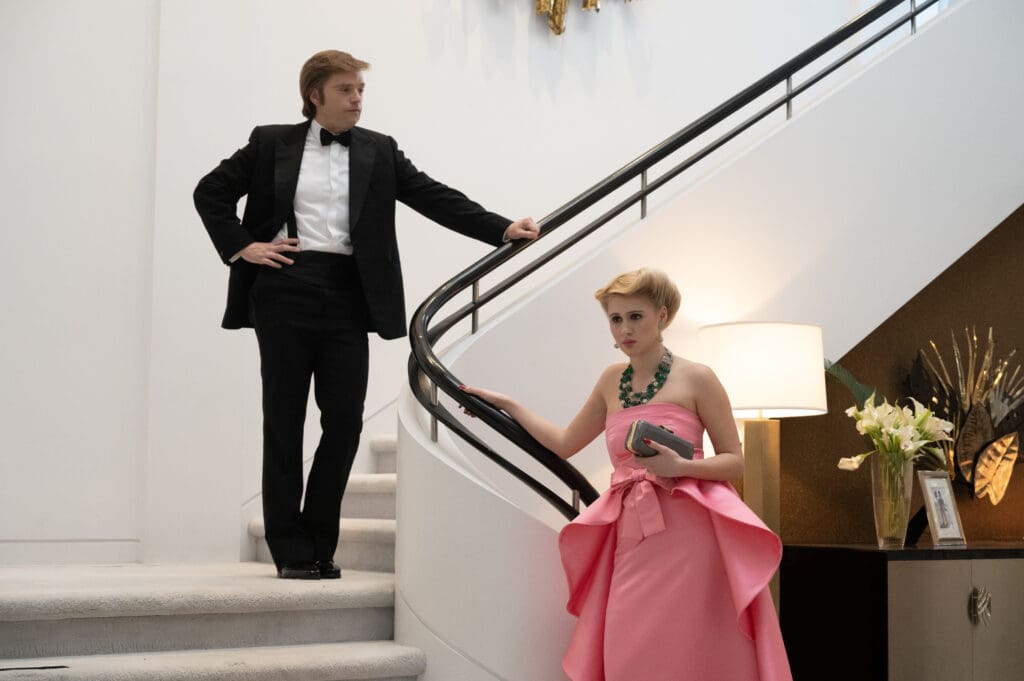
The Apprentice concludes with the death of Cohn from AIDS, which debilitated him in the latter years of his life. As a parting tribute to his loyalty, Trump gifts him Tiffany diamond cufflinks etched with “Trump”, completing his transaction and turning from apprentice to master.
Ivana then turns to Cohn and reveals they’re fake. “Donald has no shame.”
It’s a brutal ending to one of the most revealing biopics made about a character in history.
Bird said: “He (Trump) hadn’t seen the film. He just knew that there was a film about him and Roy, and he heard through the grapevine that it was critical. I don’t know if he’s ever seen the film. I doubt it, but if he did, he’d certainly dislike being portrayed as naive and weak in need of mentoring by Roy.
It’s too bad it didn’t get a bigger play. In part it didn’t because Trump did everything he could to make sure the film didn’t get a big theater opening.”
Despite Trump’s best efforts to eliminate the Apprentice from cinematic release, the film was released in approximately 1,740 cinemas across the United States and Canada during its opening weekend on October 11, 2024.
It received major critical acclaim, and both leading actors, Jeremy Strong and Sebastian Stan, were nominated for Best Supporting Actor and Best Leading Actor at the Academy Awards.
Sometimes you can’t just ‘Attack, Attack, Attack’.