In a museum in Kansas, the spacecraft that almost killed three men sits under the lights, fully restored. The film that told their story helped keep the space programme alive. Shannon Whetzel, curator of the Cosmosphere, on history, Hollywood, and why we still need both.
There is a command module in Hutchinson, Kansas, that went to the moon and came back in pieces.
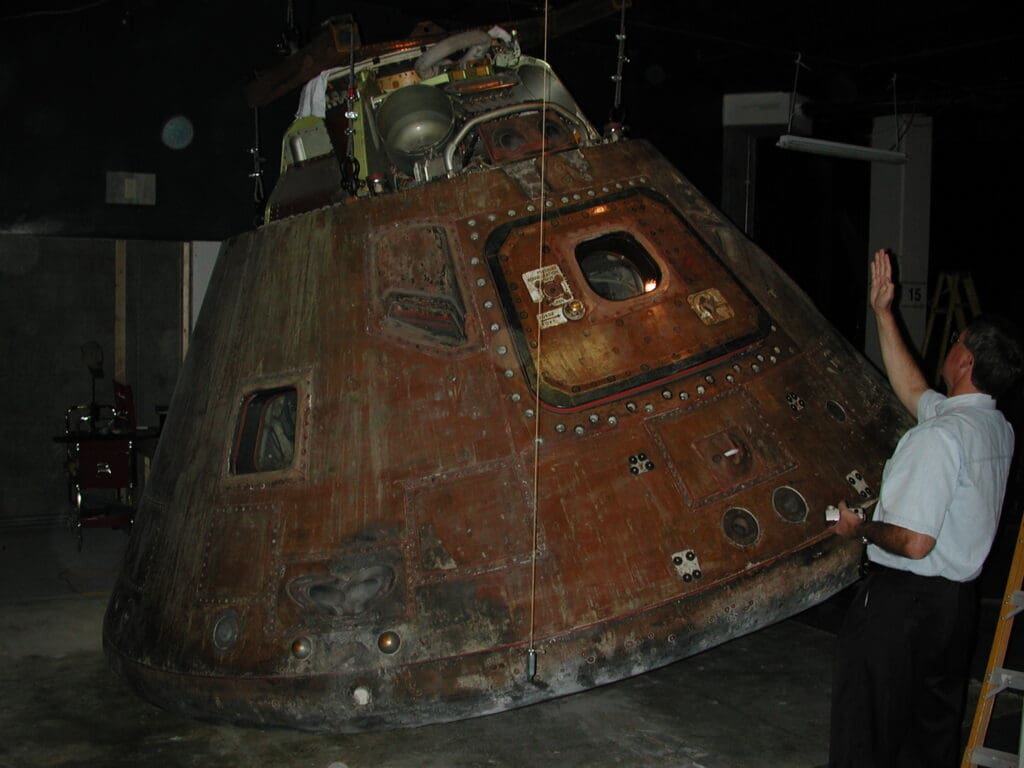
Not literally. The Odyssey; the Apollo 13 command module, returned to Earth intact on 17 April 1970, splashing down in the Pacific with its three crew members alive. But NASA took most of it apart afterwards. The craft was hollowed out, stripped of components, and eventually shipped to Paris, where it sat on display through the 1980s with little of its original interior remaining.
What you see today at the Kansas Cosmosphere is not quite the same object that Jim Lovell, Jack Swigert, and Fred Haise rode home in. It is something more deliberate than that; a spacecraft reassembled from roughly 80,000 original parts, restored between 1995 and 1997 by a team who had spent years collecting and cataloguing components by serial number before the craft even arrived from France.
“The story of the restoration has become legend around here,” says Shannon Whetzel, the Cosmosphere’s curator. “There are those few who were here when it happened. And the rest of us just get to be in awe.”
Twenty-six years old, and someone might die
To understand why the Odyssey ended up in a museum in the Kansas plains, and why anyone bothered to restore it, you have to go back to the five days in April 1970 that made it worth preserving.
Apollo 13 launched on 11 April. Two days into the mission, an oxygen tank in the service module exploded, crippling the spacecraft and ending any chance of landing on the moon. The crew had to abandon the command module, move into the lunar module, and use it as a lifeboat; a contingency that had been theorised since Apollo 8, but never tested.
For the next four days, mission control in Houston worked around the clock to bring the crew home. The solution they found; navigating a course correction, managing dwindling power, working out how to scrub carbon dioxide from a cabin designed for two, has since become one of the most celebrated problem-solving exercises in the history of human spaceflight.
Drag the rocket to explore key mission events. The oxygen tank explosion occurred at 83% of the journey, roughly 321,860 km from Earth.
Whetzel offers a detail that reframes the whole story. “I think the average age of mission control was around 26,” she says. “So these were young men making life and death decisions. Brilliant young men who were at the forefront of this amazing technology that the previous generation knew nothing about.”
It is easy to forget that amid the mythology of the space race; the astronauts, the rockets, the Cold War scorecard. The people on the ground were barely out of university. The men who figured out how to bring Apollo 13 home were, in many cases, doing it for the first time. There was no precedent. There was no manual.
“The astronauts get lots of credit,” Whetzel says. “But it’s a story of mission control as well.”
When Hollywood came to Kansas
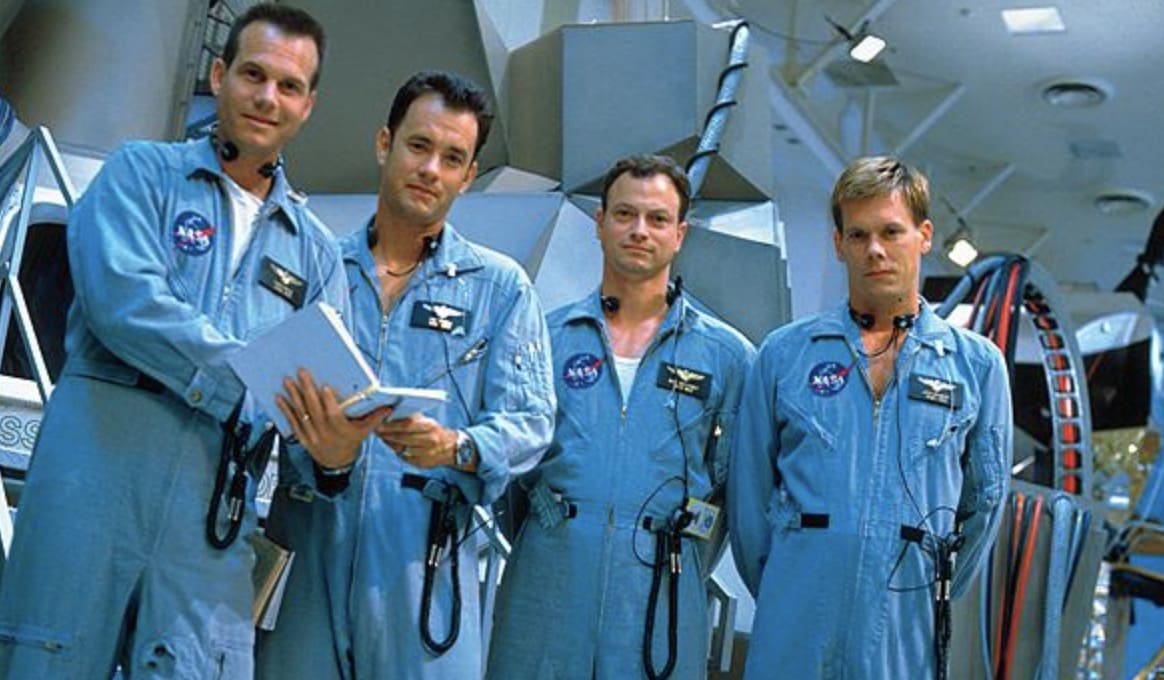
In 1995, Ron Howard released Apollo 13, starring Tom Hanks as Jim Lovell. The film was a blockbuster. It was also, in a quietly remarkable way, partly made in Kansas.
The Cosmosphere’s space race division, the same team that was restoring the Odyssey, contributed props to the production. Flight suits. Hasselblad camera parts. Hatch doors. “Our team was part of the movie,” Whetzel says. Some of those items were returned to the Cosmosphere after filming and entered the collection.
“I could talk about our collection forever,” she says, with the enthusiasm of someone who genuinely could. “I just go over like, this is the one that Tom Hanks wore.”
It is a strange kind of provenance. The suit was made to represent a real suit, worn by an actor to represent a real astronaut, and is now held in an archive alongside items from the actual mission. History and its reproduction sitting in adjacent drawers.
But that blurring of lines is, for Whetzel, part of the point. The film did something the museum alone could not: it put the story in front of millions of people who had either never heard it or had forgotten it. “Apollo 13 was such a blockbuster,” she says. “It was definitely always on people’s minds.”
The question of what a film owes to historical accuracy is a familiar one. The more interesting question, perhaps, is what history owes to film.
Baby boomers, space cereal, and the cost of enthusiasm
The Apollo programme did not have unanimous public support. It was expensive, dangerous, and, to its critics, a spectacular distraction from problems on the ground. In 1966, Martin Luther King spoke against the space race as part of his Poor People’s Campaign, arguing that the money was better spent on Earth. He was not alone.
Whetzel offers a generational reading of how the programme survived its critics. “If you look back at the history of the space programme, it was actually the baby boomers who really felt the excitement,” she says. Their parents, the so-called Greatest Generation shaped by the Depression and the Second World War, largely thought it was a waste of money.
But the boomers grew up on space cartoons and space toys and space cereal. They were the market, and the market was enthusiastic. “It was all of that marketing done for them who really kept it going,” Whetzel says.
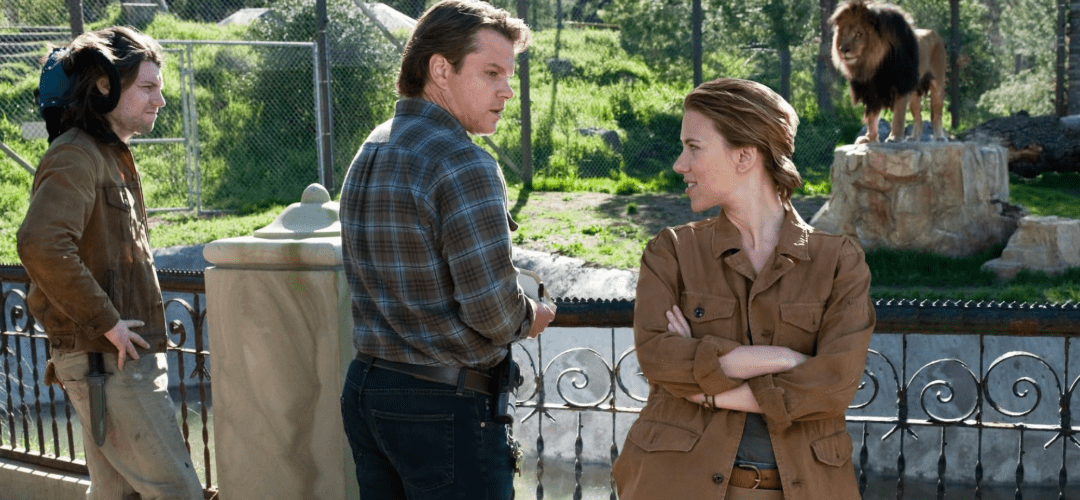
Film, she argues, plays the same role now. “I think in some ways it’s the movies, it’s Matt Damon on Mars growing potatoes. Things that really ignite the imagination and keep people interested in the space programme.”
There is something slightly uncomfortable in this observation, and Whetzel does not shy away from it. Keeping the public invested in space exploration requires, on some level, giving them a story they want to believe in. Whether that story is a cereal box in 1965 or a Ridley Scott film in 2015, the mechanism is not so different. The dream has to be sold.
Where it starts and where it might go
The Cosmosphere’s permanent gallery begins with a V2 rocket from the Second World War. It is a deliberate provocation. “To me, we go to space to better mankind,” Whetzel says, reflecting on the jolt she felt when she first encountered it. “That’s my era. So to learn that our space programme started in World War Two with weapons…I mean.”
The gallery ends with the Apollo-Soyuz Test Project of 1975, the first joint American-Soviet spaceflight, and a symbol of cooperation at the height of the Cold War. From a weapon designed to kill, to a handshake in orbit. Whetzel calls it “a brilliant way to end.”
Today, the story has new chapters. Artemis. Mars. Private companies with plans to mine the lunar surface. The excitement is real, “we’ve seen an uptake in visitors and general interest in the space programme,” Whetzel says.
History, she notes, has a habit of repeating itself. The commercial pressure that now drives space exploration is not so different from the Cold War competition that drove it before. The technology is newer. The stakes, in some ways, feel both bigger and harder to articulate.
And in the middle of all of it: a restored command module in Kansas, holding 80,000 pieces of the original thing together. A film that made millions of people care about it.
The past, as ever, is not quite finished.
Check out our Histo-View on Apollo 13 here.