Sean Porter was a deputy probation officer at Camp Vernon Kilpatrick, with one simple idea: to change the lives of the kids in his juvenile detention centre.
He wanted to bring them together through American football. And so, the Kilpatrick Mustangs were born. Porter took 11 kids with troubled pasts and rallied them to a historic playoff run in 1990.
It’s as close to a fairytale story as you could ever imagine, and when director Phil Joanou was approached for The Gridiron Gang, a film that would tell the unique stories of Porter and his players, it was an offer he was never going to refuse.
Histoflick sat down with Phil Joanou to discuss what inspired him to take on the project, working with real inmates, and what it took to bring this story to life, 20 years after its creation.
The inspiration behind the directing process
“I’m a huge American football fan, so that was the very initial draw,” he said. I’ve always just enjoyed the visual quality of American football, it’s really unique in the sense that most sports have a continuous flow”.
“It’s naturally dramatic, it’s got a beginning, middle, and end every play, so I’ve always been drawn to that from a storytelling perspective.”
“Then when I read the script, I was really drawn to the heart and soul of the story.”
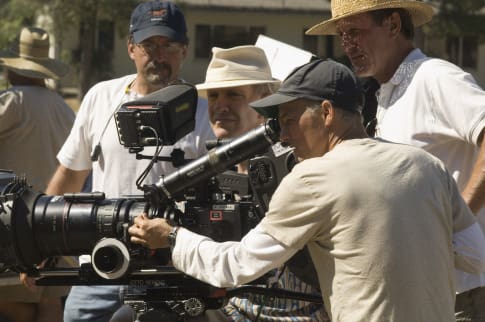
Every single player had a different story, a different past, and Joanou got the opportunity to talk with Sean about this throughout the film making process. He credits Porter massively.
“I talked to the real Sean, and some of the real kids that were in the original documentary, and found that really inspiring too, here are these kids that came from really difficult homes, tough neighbourhoods, had been thrown into this prison for young adults, and this guy got these enemies to play together.”
“I found that very moving,” he noted.
When the Mustangs overcome the challenge of finding teams in the area that agree to play them, they’re a ragged team, without synchronicity or direction. They lose.
Willie Weathers, a key figure to the team loosely based on the story of Michael Black, calls a huddle after receiving a brutal hit from an opponent. He calls a huddle, rallies the team, and chooses the play.
Upon the snap, the entire offensive line shields the quarterback. Weathers catches the handoff and uses a seam along the side-line to power through for a touchdown.
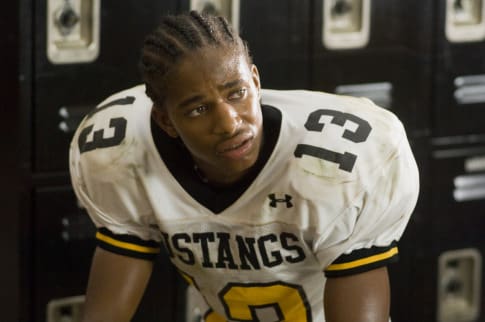
If you placed the scene next to an NFL game, you’d find overwhelming similarities in the way that it’s filmed, and this isn’t a coincidence.
“Other than being inside the huddle, when the play starts I really wanted to maintain an observance like you would if you were there, as opposed to being inside it (the huddle) and kind of cheating like a lot of football films do.”
Joanou chose to hire two NFL camera operators to achieve this, to try and give the film as much authenticity as possible.
“For everything else, the dramatic storyline, I wanted to keep a documentary-ish feeling, which is why the whole thing is handheld, it’s all longer lenses and it’s always moving.”
He also found significant inspiration from Michael Mann’s The Insider, and particularly his camera movement, using it as a template for the dramatic scenes in the film.
Dwayne Johnson, and his role of playing Sean Porter
With Dwayne “The Rock” Johnson’s roots in American football, it comes as no surprise that he was cast to play the role of mentor and coach, Sean Porter.
“I think that he did a great job, he really embodied the moral and ethical foundation that Sean Porter has, and was trying to communicate with these kids.”
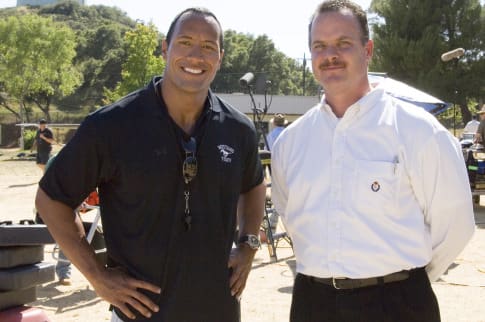
“Sean was very happy with how accurate the Rock’s portrayal was, he would come to the set quite a bit.”
It was reported that Porter wasn’t too pleased with the film being made at the beginning, with the worry of Hollywood dramatisation ruining the perception of the real players involved. He also worried that if one of the player’s current employers found out about their past, it could greatly affect their lives.
Subsequently, the names of the inmates in the films were made fictitious, to protect their safety.
“Sean was tough, just like you see on those movies, to the point where the administrators said that the camp were getting upset with him for being too aggressive.”
“Dwayne captured both his singular drive to make the program work, and to fight the system, as well as his coaching style and brought his own physicality to the role.”
Working with real inmates
When it came to making the film, authenticity was of utmost importance. In his own words, he estimated that the film is around 80-90% accurate.
Part of doing this to the highest degree was shooting in the real camp, and dealing with the difficulties that came with it. He recalls the lengths that he had to go through, from start to finish, to get the film over the line.
“It was a fully working facility, and it took a lot to actually get in there.”
“Not only was Sean worried about us getting in, but Sean was no longer working there and had actually moved on to a different camp.”
“The administrators were very worried about this big Hollywood film crew, and there was a lot of concern that we were going to turn the story into a Hollywood drama, or maybe even make it look worse than it was there.”
“We almost didn’t get in; we actually had to go to the city council in Los Angeles and get a vote to allow us.”
Now that the production team had been given the green light, filming could commence. This process would be far from straightforward, as Joanou recalls.
“Being there was tough, because every time you went in, you’d go through all the security, and then you’d shoot, and then you’d go out for lunch to eat in the parking lot, so there was a lot of time going in and out. We had to be very secure.”
“We used some of the inmates in the background too, they became extras in the film, which they enjoyed, better than doing yard work!”
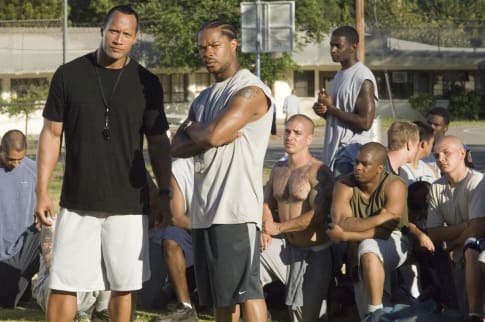
The inmates quickly became complimentary of the film, according to Joanou.
“I know for a fact that because they were all there watching this film, they all saw the movie. We had a big premiere at Camp Kilpatrick, where all the inmates and all the administrators came, and Dwayne (Johnson) came, and all the actors came, and they all went crazy, they really admired the film, and the administrators were proud of the way we depicted the camp.”
The emotion that Joanou tried to bring across in the film was shaped by his real-life experience working with the inmates, and being almost a fly on the wall for the incarcerated kids, that “nobody cares enough” for.
“It was an eye-opening experience, it was educational for all of us.”
“It gave me a lot of sympathy. I already had a lot, but children grow up in an environment that can be violent, where they don’t have both parents, or in some cases, there’d be kids that we’d get out, and nobody would come and pick them up.”
“Nobody on the planet cares about this kid? Really? Imagine how alone you’d feel if you’re 14 or 15 and nobody cares enough to come and help you.”
“It was really a very moving experience, we weren’t faking any of it, that was exactly what the place is.”
Many of the Mustangs team were incredibly young during filming. Jade Yorker, the actor depicting Willie Weathers, was 19. David V. Thomas was 18 when he was cast as Kelvin Owens. The rest were ages of 16 to 22. For many of them, this was a coming-of-age experience.
“Being around the real thing helped the actors realise the situation.”
“I think it helped the portrayal to see what the real kids were going through behind them, and then have to portray that on camera.”
“They called me coach”
Revisiting the coming-of-age experiences, the young age of the actors also meant that for many, it was their first acting role. In a movie whose scenes rely on synchronicity between each other, Joanou compared the director’s process to being a conductor.
“You have to have in your head where you think it needs to go; I think of it as a conductor, who knows in the symphony when the orchestra needs to be loud, when it needs to be quiet, and when it needs to be fast or slow.”
“There’s rises and falls throughout it, and by the end it’s supposed to crescendo, and deliver, and slow down at the end, it’s a symphony.”
There was also an art of simplicity to helping the actors individually.
“Anthony Hopkins said his four favourite directions were faster, slower, louder, quieter. He said that’s all I need. I know the character, but if I’m going too slow, tell me to go faster, If I’m too quiet, tell me to go louder, and I honestly thought that was so true.”
“These kids themselves are going through the ups and downs of the day, and it might be 7AM and theyve got to be ready to rock!”
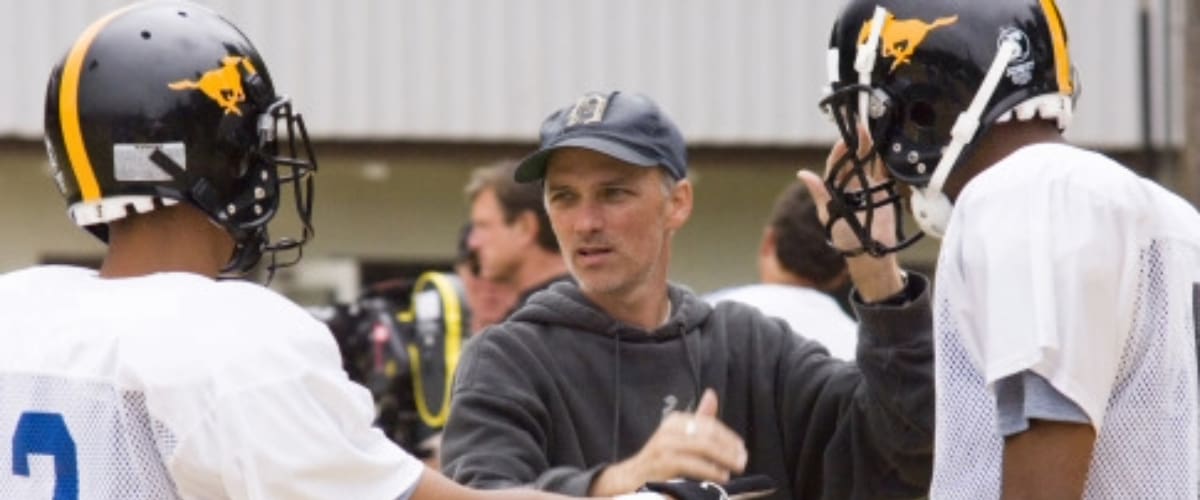
“Whether it’s to run a play or get in each other’s face, I had to get into coach mode, and they even started calling me coach.”
“There was a tremendous amount of effort putting in to exactly what you’re talking about, which is getting them to the right point of energy that the story needed, which was changing all the time.”
If you could give people one message to take away from the film, what would it be?
“Everybody needs, everybody wants that sense of family, that sense of belonging, that sense of being part of something outside ourselves. Family can be where you work, your actual family, your group of friends, or what you’re a part of. I think a lot of these kids came into Camp Kilpatrick, to some degree, abandoned by their families, or by their community, or one their own, or helpless.”
“And I think what Sean did was say rather than tough luck, or that you’re in here because you screwed up or that society says that you dont fit in, he said wait, you can fit in, you can be part of a family, and in this case it was the Mustangs, and the real life story really inspired me.”
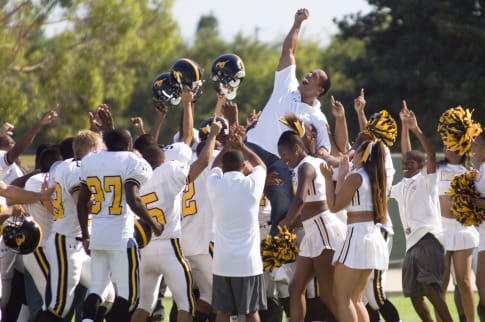
“It was a great experience for me, on a human level, because it really opened my eyes, it showed me a world I’d never seen before, and hopefully I got to show the people that role as well.”
Read our other American football articles here.