For the UK release of ‘Leonora in the Morning Light’, documenting the life of surrealist painter and novelist Leonora Carrington, Histoflick writer Matt Stanger attended a Special Q+A after a showing of the film with directors Lena Vurma and Thor Klein at the Showroom Cinema in Sheffield. The film itself adapts its title and core narrative from Leonora, the intimate biography written by the celebrated Mexican author Elena Poniatowska.
After a pleasant introduction hosted by Melanie Iredale from Reclaim the Frame, co-director Thor Klein tells the mostly packed audience, “I encourage you to feel the sensuality of this film, not think your way through it.” Already I’m intrigued.
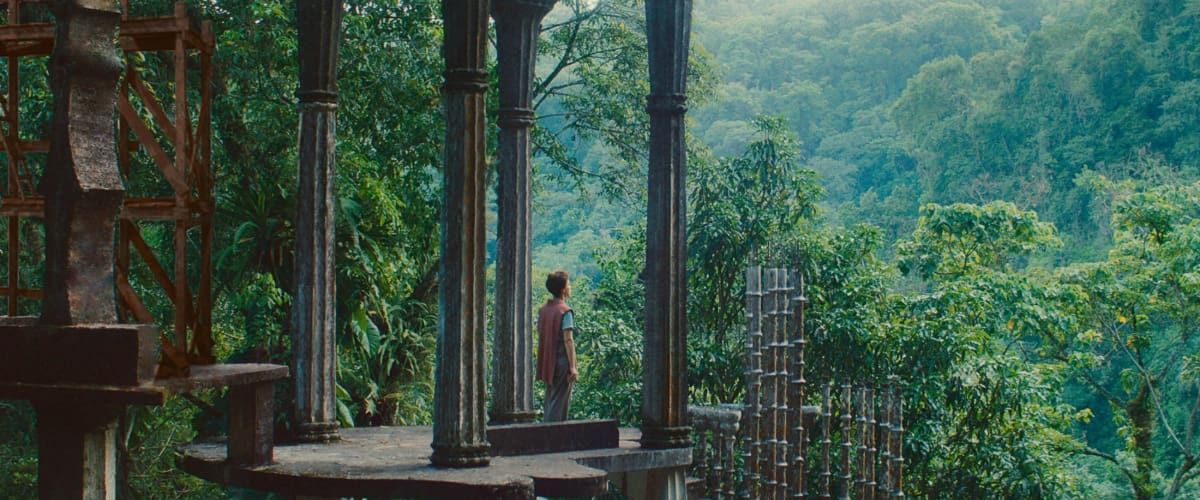
Mexico, 1951. Carrington, played by Olivia Vinall seems settled in life with her Jewish-Hungarian husband Emerico “Chiki” Weisz (István Téglás), traversing the luscious greenery of the Las Pozas, a surrealist oasis in Xilitla, Mexico. In the garden today references of surrealist pioneers such as Max Ernst, Carrington and others can be found there.
The garden was designed by her collector, Edward James, who still has original Carrington’s in his home. When they visited, co-directors Vurma and Klein said: “We felt like we were in a liquid painting”. Testament to the pair and cinematographer, Tudor Vladimir Panduru, whilst the cameras shoot amongst the vivid greens are trance-like, reflective of Carrington’s surrealist views.
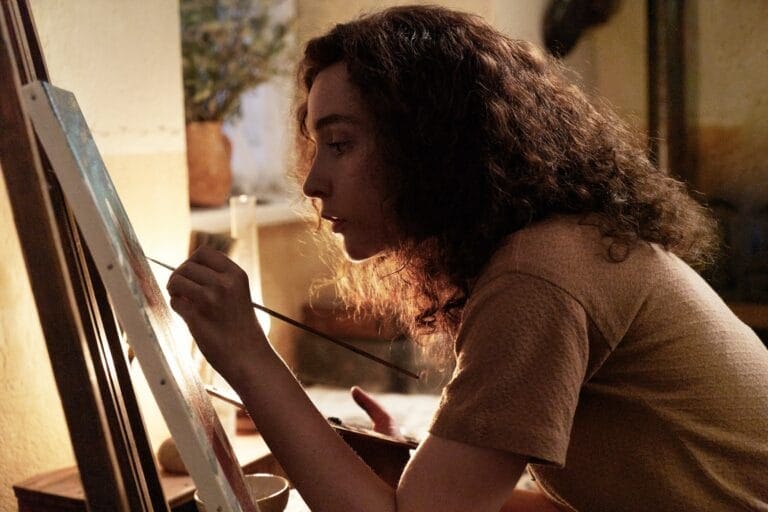
The directors chose only use the colour palette Leonora used in her art, echoing the brilliance of her work. Interestingly, they don’t use any paintings of the artist in the film. On this decision, Klein explains: “The reason why we speak about all these paintings is because they are so brilliant from a compositional point of view, just from the quality of visual language and when you show them in a large frame, usually the image, the painting will naturally lose against the large frame.”
They cite a quote that Leonora gave in an early noughties interview with an art critic in Mexico, which they kept in the back of their mind throughout making the film. “She said to the interviewer, ‘Don’t intellectualise my art.’ and this was a clear warning that if I do that, the film will die”.
“So for us, the film should feel like a painting.”
Mexico was where Carrington spent most of her life. In 1942, she set sail for the country, following a path set by many artists before her. But in Leonora in the Morning Light, it is not this part of her life that is studied, instead the unique tale of her life in Europe is what Vurma and Klein analyse.
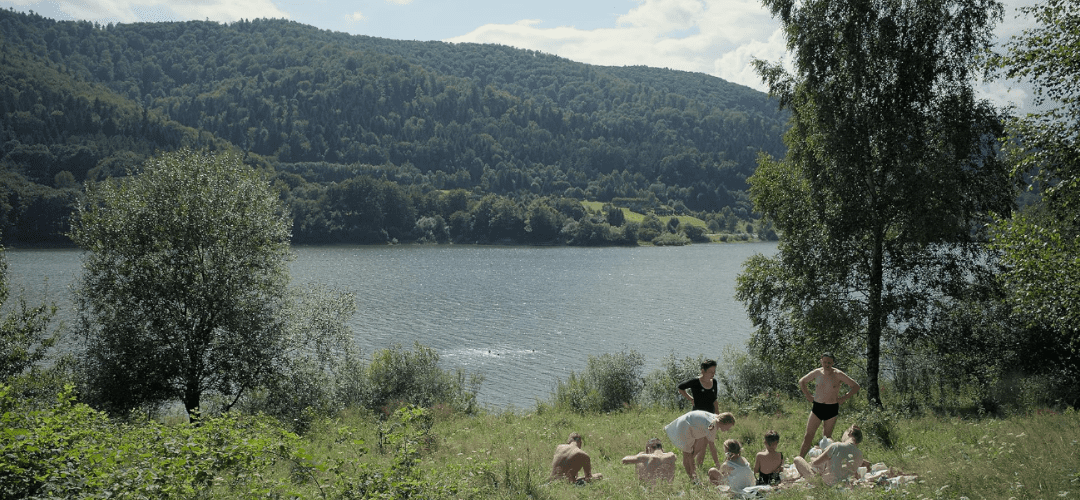
Paris. 1938. On the brink of the war, Carrington is living with fellow surrealist Max Ernst; after meeting the year before. Ernst (who’s trying his very best to escape a past relationship) is infatuated with Leonora, and the pair relocate to Saint-Martin-d’Ardèche in Southern France. They spent their time painting together, building sculptures and even skinny-dipping in the lakes of the town to the disgust of locals. How surrealist.
Speaking on their relationship, Klein said: “I think the time was so formative because she learned a lot from him, he also was inspired by her.” Klein also credibly mentions that they left out a period of Leonora’s life in the film where she enjoyed the company of other men. Verma says, “It was like this kind of big summer of love that you have, but you know it’s going to end at some point, but then I think both of them knew at some point that they might clash because both were artists in their own right.”
But throughout their time together, they both comment on a constant threat of danger hanging over their conscience, and this tragic foreshadowing comes true when Ernst is taken by French authorities in the wake of Hitler’s invasion of France, labelled as a ‘hostile alien’. Ernst pleads the case that he is anti-Hitler, but this is not sufficient.
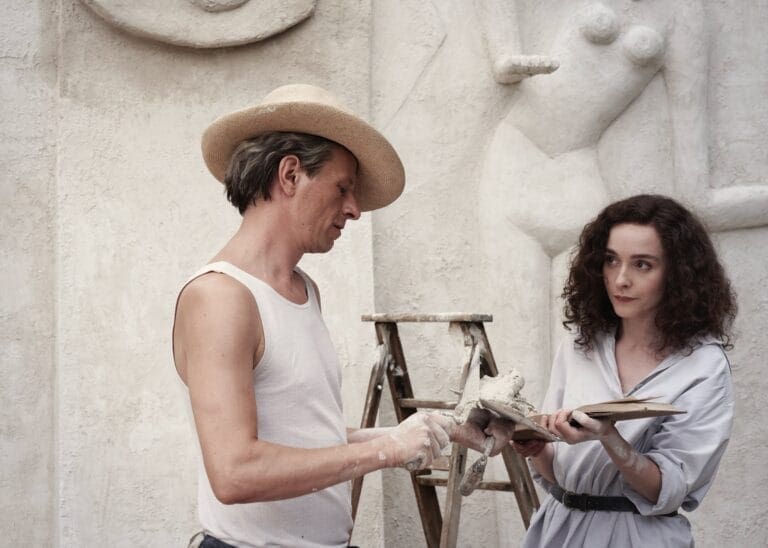
From the moment that Ernst is alienated from Carrington’s life, some sort of dark, ethereal spirit consumes her, bounding through the walls and it leads to her being taken to Santander, Spain, in a psychiatric hospital, where she undertakes numerous rounds of electric shock therapy. It is worth noting that EST is a tool that has been used frequently not just in history, but in cinema to silence creative voices.
In their research the directors visited Charité in Berlin, one of the largest and most prestigious university hospitals in Europe. EST is still used in modern times but with anaesthesia, and it’s been proven to help patients.
Vurma said: “It was just important to kind of do it justice in the sense that we did a lot of research how it was actually done back then, and also we had real nurses on set who actually played the nurses, so that it’s not exaggerated, but also that it’s basically how it was. So it does feel very real, which is a bit scary, but on the other hand, yeah, we didn’t want to exaggerate.”
Speaking on the cinematic meaning of EST, Klein said: The difficulty with scenes like that is that you want to avoid the cliché because it’s such a cliché, the crazy artist, the borderline between crazy and genius. It’s really, it’s very easy to walk on all these traps, so for me, in the beginning, it was really important to understand what really happened as much as possible.
Klein visited a psychiatric ward to discuss Leonora. “I talked to the doctor there who runs the ward, and I asked her if we could look at Leonora, but only based on symptoms and forget for a second that she was a famous painter, and she said that what Leonora experienced is very typical for schizophrenic psychosis.”
It was clear that the directors wanted to ground this scene in reality, and communicate that resilience was one of Leonora’s proudest characteristics. “She kept on creating and found a balance with her mental health issues she had so I think it’s very different to other biopics about artists where they end usually grim, either they’re poor, die, cut off their ears or something similar.” says Vurma, referencing the great Van Gogh amongst others.
This resilience is exemplified further by the two animals that Leonora is almost immortalised by, the horse and the hyena, which Vurma interprets as her ‘inner beast’. Speaking on the hyena Klein references the strange features of the animal.
“It’s the only animal, just to give you an idea, it’s the only animal that where the female has a penis, but it’s not a penis, it’s an inverted clitorus. It’s the only animal where the man cannot really force themselves upon the females so a lot of things made a lot of sense when you look deeper into it.”
Perhaps the hyena symbolism translates to her being the founding member of the Women’s Liberation Movement in Mexico in the early 1970s. She firmly believed that women possessed legendary powers and actively urged them to reclaim their rights.
Cyclically, the film ends in Mexico back in 1951, where she is at peace. On that decision, Verma said it was an important one. “I think that the ending is a very hopeful one and it’s a new beginning.” For the filmmakers, they wanted to finish her story when she was at peace, and this continued for the rest of her life.
Clearly, Klein and Verma were committed to the life of Leonora Carrington, and it’s certain that they did not intellectualise the pioneering surrealist as Klein worries, but instead display her life as a resilient statement on society.
Leonora and the Morning Light is touring various independent cinemas and arts centres this summer, featuring special Q&A sessions with the directors at select venues.