With his image deeply ingrained in our collective cultural consciousness, Adolf Hitler remains a figure many deem too daunting to put on screen. Yet, behind the eerie presence lingering in history textbooks lies a century of high-stakes cinema. From the satire of Charlie Chaplin to the psychological breakdown of Bruno Ganz inside the bunker, filmmakers have repeatedly struggled to confront, deconstruct, and battle the visual legacy of history’s greatest evil.
There’s arguably no face in the world more recognisable than that of Adolf Hitler. It is a face that has inspired terror, that has represented malignant evil, that has represented the most banal of humanity. He is a figure that many would deem too daunting to put on screen, it is far easier to portray Nazis as faceless henchmen, leaving Hitler’s eerie presence lingering in textbooks rather than a character brought to life.
In many ways, it is remarkable that, despite so few canonical filmic portrayals, Hitler’s image remains so ingrained in our collective cultural consciousness. When he does appear on screen, those appearances are among the most carefully scripted in all of cinema, delicately avoiding the glamorisation of one of humanity’s greatest villains. Yet, there are times when cinema does boldly attempt to go beyond mere reproduction of the historical figure, offering audiences a set of competing images – that of the mythic leader, the absurd caricature, and, perhaps most of all, the unravelled human being.
To portray Hitler on film, then, becomes not merely an act of historical representation, but a far bolder attempt to develop and shape our collective cultural consciousness of history’s greatest evil.
The Manufactured Myth
To understand the construction of Hitler on screen, it is not enough to begin with the Western adaptations that followed the Second World War. The way in which we still interpret Hitler to this day was shaped by the cinema of the regime itself.
Central to this were the films of Leni Riefenstahl, notable not just as one of the few female filmmakers in the world in the 1930s, but moreover as Hitler’s chief cinematic propagandist. Her films, Triumph of the Will (1935), Victory of the Faith (1933), and Day of Freedom: Our Armed Forces (1935) transformed Hitler’s infamous Nuremberg rallies speeches from mere political documentation into eternal echoes of tyranny that travelled across the globe. Through sweeping camera movements, monumental compositions, and the careful choreography of mass crowds, these films presented power not simply as authority but as spectacle. Hitler is elevated to a place of grandeur, framed as a stoic hero, and mythologised as a patriotic warrior.
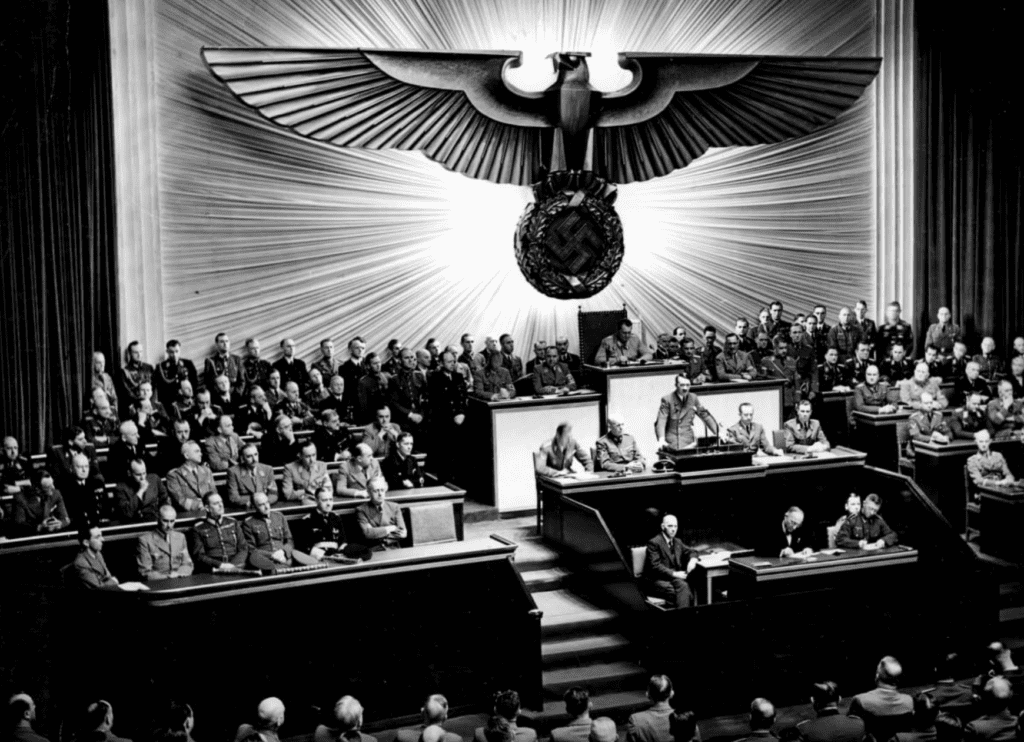
As historian and political theorist Roger Griffin, emeritus professor in modern history at Oxford Brookes University, explains, fascism cannot be understood purely as a politics of destruction. “It’s not just destructive, it’s also creative,” he argues, pointing to the regime’s attempt to construct an entirely new sense of national reality through symbols, rituals, and, crucially, images.
Cinema As Propaganda
Cinema was at the forefront of this process. It is tempting to view Nazi film purely through the lens of propaganda, as overt, ideological, and unmistakably political. Yet this risks misunderstanding the function of cinema within the Third Reich. The majority of films produced under Nazi rule were not explicitly ideological at all. They were comedies, romances, melodramas, indeed, on the surface, they were indistinguishable from the zeitgeist elsewhere in Europe and Hollywood.
However, they served a deeper, more cynical and sinister purpose – that of normalisation. As Roger Griffin suggests, cinema operated as “a mixture of escapism, normalisation and propaganda,” creating an environment in which ideology was not imposed upon audiences, but absorbed into the rhythms of everyday life. For viewers, the experience of cinema was not one of constant political instruction, but of familiarity.
Simultaneously, the works of Leni Riefenstahl ensured that everyday reality was underpinned by a powerful mythic vision. The image of Hitler that emerges from those films is therefore not simply political, but symbolic. He was painted as a figure elevated beyond the ordinary, constructed through scale, movement, and repetition into a superhuman figure.
This is ground zero for the representation of Hitler on the silver screen. He was constructed through carefully curated, staged, and aestheticised images, and all subsequent portrayals have, in some way, responded to that image. But therein lies the problem. Cinema, with its capacity to render power as visible, compelling, and even awe-inspiring, went a long way to construct that initial myth. Unconsciously, it is that image of Hitler from Triumph of the Will, standing arm aloft as the most powerful figure in all of history, that is how most people see him. For that reason, perhaps Riefenstahl, and in turn Hitler and Goebbels, were successful. It is still in that initially Nazi-constructed image that we view Hitler.
Turning the Tide: Satire as a Weapon
That isn’t to say that there hasn’t been a conscious effort by filmmakers to deconstruct that image. Perhaps no greater effort has been made to that end than by Charlie Chaplin in 1940 with The Great Dictator.
It was perhaps inevitable that Chaplin would satirise Hitler – the two seem almost inconceivably linked. Born just four days apart in April 1889, up until Hitler’s rise to power in 1933, Chaplin had practically trademarked the small toothbrush moustache as the central distinguishing feature of his ‘Little Tramp’ persona. Chaplin sought to undermine the Nazi image of Hitler’s power through satire, something previously attempted in Hollywood only by The Three Stooges in You Nazty Spy! (1940).
As film scholar and author of Chaplin’s biography, Charles J. Maland notes, Hollywood in the late 1930s was broadly reluctant to engage directly with European politics. Restricted in part by the Hays Code, studios were cautious, wary of alienating audiences or provoking controversy at a time when the United States remained officially neutral. Within this context, Chaplin’s decision to satirise Hitler went beyond an artistic choice.
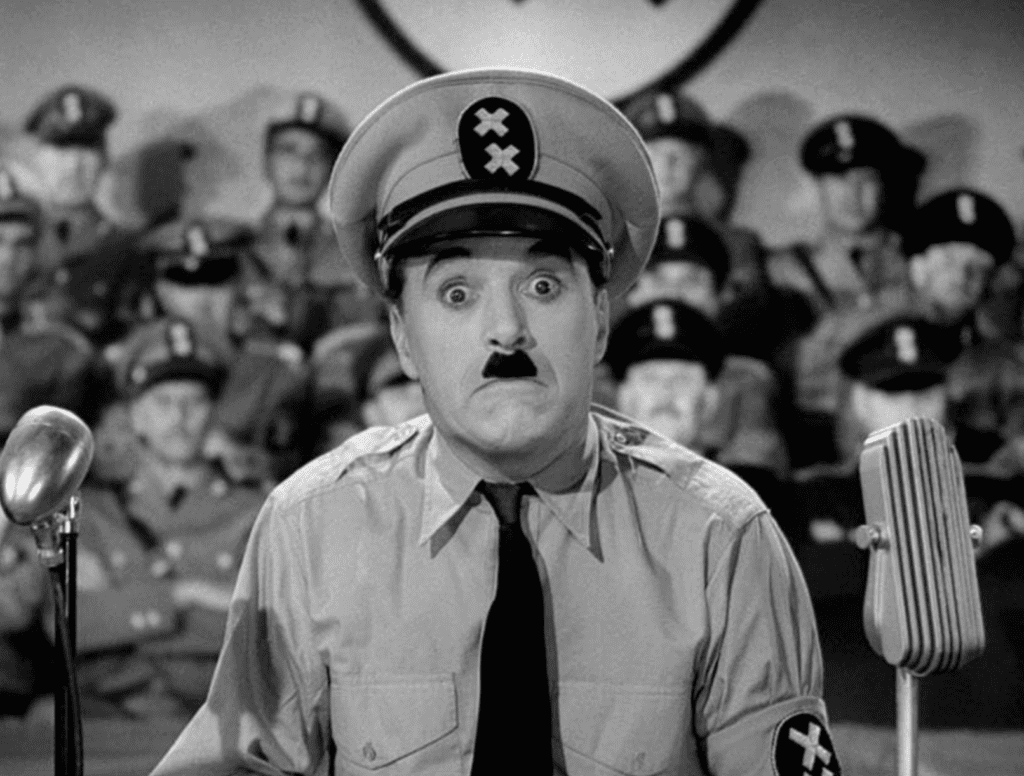
“Chaplin was in a unique position,” Maland explains, “he was economically independent from Hollywood in a way that almost no director was.” With his star power greater than the limitations of the studio system, Chaplin sought to make a film that actively shaped the political climate, rather than simply satirising it. In The Great Dictator, that confrontation takes the form of Adenoid Hynkel, a character who at once mirrors Hitler and dismantles him.
Where Riefenstahl had elevated Hitler into a mythical entity, Chaplin reduces him to something performative. Hynkel is volatile, theatrical, and deeply insecure, his authority constantly undermined by its own excess. His speeches collapse into bursts of pseudo-German nonsense, his movements exaggerated to the point of absurdity. Power is no longer monumental or desirable, but rather something that makes Hynkel more akin to a clown.
Yet this is not a simple caricature. As Chaplin scholar Lisa Stein Haven outlines, Chaplin’s approach was rooted in careful observation. “He studied Hitler’s gestures and rhythms closely; he wanted to replicate him so that people would recognise Hitler, then push it just beyond credibility.” The effect is subtle but significant; what had once appeared authoritative is revealed as glaringly fragile.
The tension is perhaps most striking in the film’s famous globe sequence. Alone in his office, Hynkel dances with an inflatable world, tossing it lightly into the air, cradling it, spinning with it in a moment of almost childlike delight. For a fleeting moment, power seems beautiful, then, without warning, the balloon bursts, the illusion collapses, and the clown is revealed.
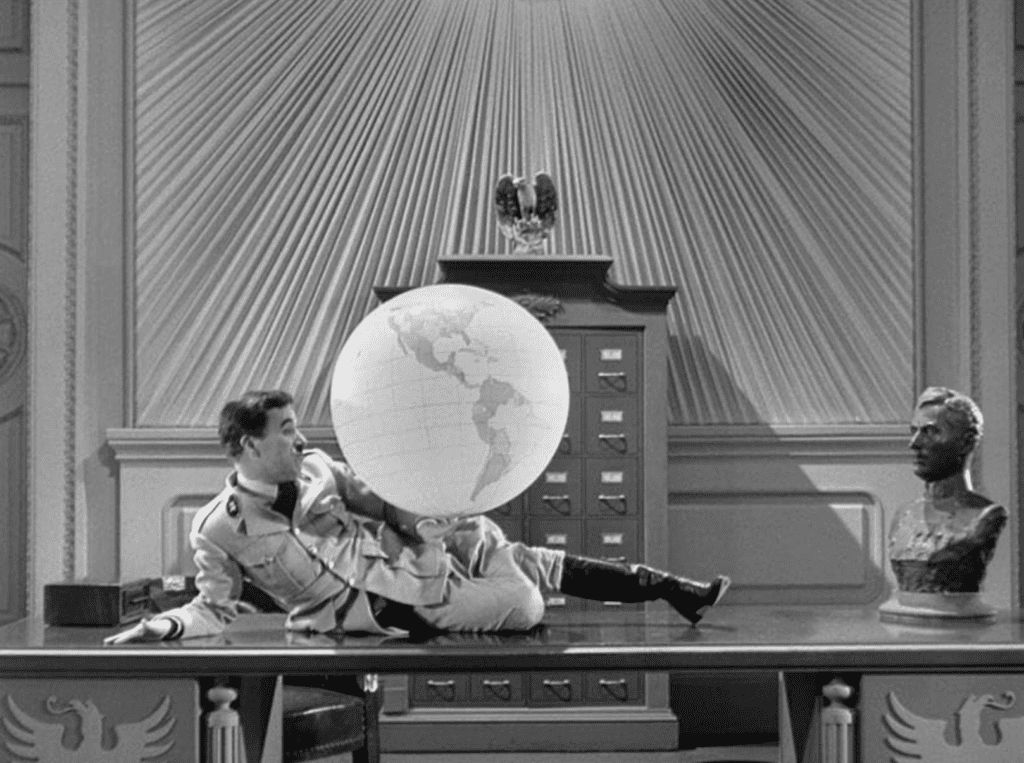
In that moment, Chaplin does not merely mock Hitler – he exposes the mechanics of his image, dismantling the spectacle of Riefenstahl’s cinema as pieces of illusion.
The effectiveness of Chaplin’s intervention lies in its use of comedy, a tool that may seem ill-suited to confronting authoritarian power.
For Stein Haven, however, comedy is precisely what makes the film so potent. It is “the sharpest critique”, capable of exposing contradictions that more serious approaches might leave intact. By rendering Hitler ridiculous, Chaplin strips away the aura of inevitability that Nazi imagery had so carefully constructed.
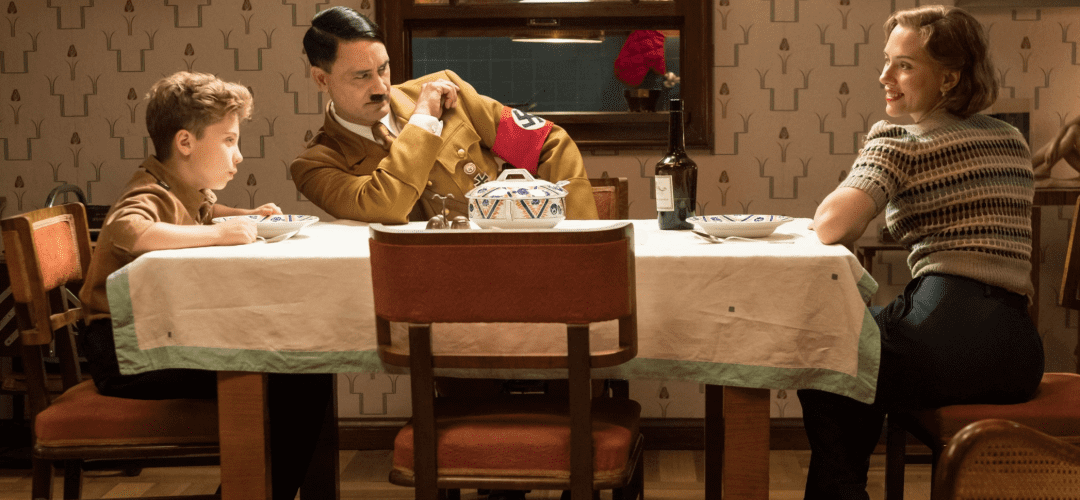
This dynamic has not disappeared in portrayals of Hitler, and indeed of authoritarian power. The Death of Stalin (2017) satirised the mythic image of another great dictator, Joseph Stalin, whilst in Taika Waititi’s Jojo Rabbit (2019), Hitler appears as a childish imaginary companion. He is absurd, exaggerated and shaped by fantasy. In Look Who’s Back (2015), he is reintroduced into modern society as an object of uneasy humour. In both cases, satire continues to function as a means to strip away that original myth, echoing Chaplin’s earlier intervention.
Yet these portrayals also introduce a new tension. The closer Hitler is brought to the everyday the more accessible and recognisable he becomes, and in turn the more difficult it is to maintain distance from the figure itself. Laughter, then, does not necessarily resolve the problem of representing evil; it only reframes it.
Catharsis vs. Realism
In the decades that followed the war, filmmakers continued to grapple with how, and whether, Hitler should be placed on screen at all. Early portrayals often kept him at a distance, appearing only briefly, or as an off-screen presence whose influence was felt – further echoing Riefenstahl’s construction of him as a mythic figure. Even when he did appear, as in Countdown to War (1989), in which he is portrayed by Ian McKellen, the emphasis remained on the broader political machinery of the regime, and only sustained the illusion of Hitler as mythical.
Elsewhere, filmmakers approached Hitler through stylisation and genre. In Indiana Jones and the Last Crusade (1989), he appears fleetingly, almost incidentally, in an ironic moment reflecting his status as a recognisable cultural figure. In Inglourious Basterds (2008), he is reimagined within a hyper-stylised revenge fantasy, his death staged not as history, but as cinematic catharsis, director Quentin Tarantino attempting to destroy Riefenstahl’s myth once and for all by burning down a cinema with the Führer trapped inside.
The most influential modern portrayal, however, is in Downfall (2004), where Bruno Ganz portrays Hitler as a collapsing, volatile figure in the final days of the Third Reich. It is an attempt to humanise him, to capture his psychological state, without diminishing the scale of his atrocities.
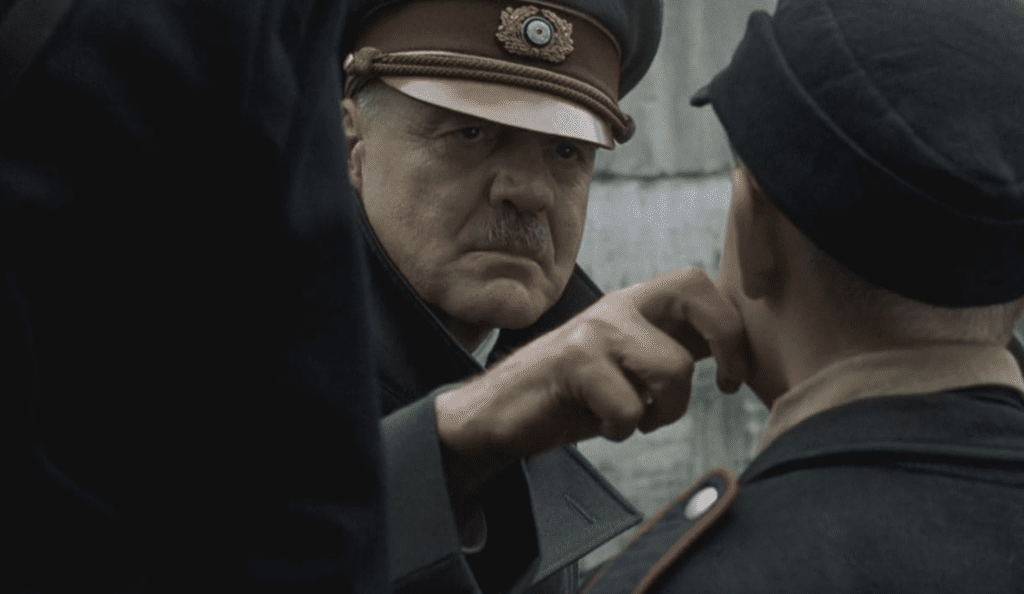
Yet even this approach is not without complication. The film was criticised at the time of its release for its historical inaccuracies – with testimony from Hitler’s personal guard, Rochus Misch, disputing some of the film’s events – and for the risk it takes in attempting to humanise, and in turn normalise, the man who, for most, stands as the face of evil.
The Issue of Representation
It is within this tension that the problem of representation becomes most acute. Portraying Hitler is not like depicting any other historical figure, but involves engaging with and combating images that were deliberately constructed to endure.
As Roger Griffin reflected, “evil is fascinating, it goes beyond the limit to which the ordinary human mind can go”, pointing to the uncomfortable pull such figures can exert on the imagination. That fascination is not incidental; it is embedded in the act of representation. To place Hitler on screen makes him visible, legible, and risks making him compelling.
Even in critique, there is a risk. The more cinema seeks to understand Hitler, the more it risks granting coherence to a figure whose power depended on performance and image. What begins as interpretation can edge towards normalisation. This is the paradox at the heart of portraying Hitler. Cinema, as a medium, seeks to organise, frame, and interpret. It turns history into narrative, and narrative into something emotionally tangible. Yet in doing so, it can transform horror into something that can be processed and understood. That understanding, however, can come with a cost.
From the monumental spectacle of Triumph of the Will to the subversive satire of The Great Dictator, and through to the psychological realism of Downfall, cinema has not simply depicted Hitler; it has continually reshaped him. Unconsciously, cinema has constructed the public perception of Hitler, and in that sense, cinema does not simply reflect history; it mediates it.
There is no single cinematic Hitler. Instead, there exists a series of competing images, each shaped by the various intentions of filmmakers and the expectations of audiences. There is a greater, more complex construction of Hitler on film, yet the original problem of Riefenstahl’s striking imagery remains.
To put Hitler on screen is to engage with more than history. It is to engage with the visual language through which that history has been remembered. That is a language that has the power not only to represent the past, but to shape its meaning. Cinema does more than simply show us who Hitler was; it shows us how we have come to imagine him.