There is a moment in almost every boxing film where the hero absorbs a punch that would have a doctor reaching for a penlight. His arms drop. His chin tilts upward, almost inviting the next blow. The crowd noise swells. Then, improbably, miraculously, he throws the counter that changes everything. It lands with a crack that echoes around the cinema. The crowd in the film and the crowd in the theatre rise as one.
It is a great moment. It just doesn’t really look anything like a real fight.
Joseph ‘Jos’ Weir has spent ten years on both sides of that divide – as a Muay Thai and kickboxing competitor, and as a coach at Great Britain Top Team in Mitcham. He started training at 15 and describes combat sport as “probably the biggest part of my life.”
From competing in Thailand and learning his trade as a Muay Thai fighter, to competing for British titles with some of the country’s best, Jos has sparred hard enough to know what a punch sounds like when it genuinely connects, and he has watched enough films to know that Hollywood rarely comes close.

Photo courtesy of FightZumi League
“It’s the little things that seemed a bit unrealistic,” he says, casting his mind back to the earliest fight films he remembers – Rocky, Warrior. “The pace and the reactions. You’d notice that after you actually started sparring and competing.”
He isn’t particularly harsh about it. Neither is he wrong.
The problem isn’t effort. The problem is geometry.
When a film crew needs to capture a punch landing, they face a logistical reality that has no clean solution: the actor throwing the shot cannot actually hit the actor receiving it, but the camera needs to see both their faces. The result, as Weir describes it, is a kind of theatrical compromise that anyone who has spent time on the mats will immediately clock. “They’ll be very, you go, I go, you go, I go – and they’ll just kind of stand and face each other in between,” he says.
In a real fight, that simply does not happen. “Fighting is just continuous ,and a lot of the time, almost except from the highest level, chaotic period of just two people constantly reacting and moving to each other,” Weir explains. “The tempo is constantly changing. They’re circling, they’re moving. They’re switching everything up.”
What cinema tends to produce instead is a kind of ritualised exchange – big hook, big hook, jab, jab — that reads clearly on screen but bears almost no resemblance to the chess match of high-level striking. The intricacies disappear. The feints, the broken rhythm, the way a fighter might step back, reset, and then pour in behind someone biting on a fake — all of it gets stripped away in the edit, in the choreography, in the fundamental difficulty of making something real look legible to an audience who has never experienced it.
“Hollywood struggles to capture the intricacies,” Weir agrees. “They simplify it. I think that’s kind of expected from Hollywood. It’s all about the wow factor. People are more caught up in just the characters themselves.”
One of the most consistent myths that cinema perpetuates is about knockouts – specifically, how they happen.
Most people believe what it takes to knock someone out and is a big punch from a big puncher. That, Weir says, is almost entirely wrong. “There’s so much more to stopping someone, to actually shutting someone’s lights off, than just hitting hard. You have to be so precise and intentional with how you hit.”
He speaks from close experience. “I’ve never knocked someone out cold, but I’ve hit plenty of people hard – probably full power – clean in the head, but just not with the right timing.”
He points to the mechanics of it whereby the goal is not simply force, but getting the brain to hit the inside of the skull at the precise angle that causes that momentary loss of consciousness. “You see people knock people out and they don’t even throw full power. It’s just the right timing, the right position.”

Image courtesy of Jos Weir
Films tend to show the aftermath of a big, obvious, telegraphed strike and a slow-motion punch arriving under a raised chin while both arms hang loosely at the defender’s sides. In reality, Weir notes, the knockout shot at the highest level usually arrives not when someone is standing exposed, but when they are mid-movement, making a calculated micro-adjustment, and the other fighter has simply read the play a fraction of a second faster. “Hollywood movies can take the chess match aspect out of it with the knockout shots for sure.”
The defence question gets to something even more fundamental. Movies need faces. The camera needs to linger on the actors who have been paid to carry the film, which means that guards drop, heads are left exposed, and the careful defensive work that defines elite combat- slipping, parrying, rolling all largely go unacknowledged.
“At the highest level,” Weir says, “their defence is so masterful and spot on that they really have to work to get an opening on each other. The majority of fights involve shots being defended.”
There are of course exceptions. Not many, but they exist.
Weir points to A Prayer Before Dawn, the 2017 film based on Billy Moore’s true story of fighting in Thai prisons, as a rare piece of filmmaking that earns genuine respect from those inside the sport. “I thought that movie was pretty realistic. It’s very raw, especially as a good representation of Thailand, specifically very unregulated. Even just the aesthetic, the pace, the chaos of it all.”
He mentions The Fighter too, the 2010 film starring Christian Bale as Dicky Eklund. “Quite a realistic depiction of a lot of the fighters’ lives. That was quite interesting.”
The word he keeps reaching for, when describing the films that work, is gritty. “The ones that come across as really raw – a bit more on the disturbing side rather than the glory.”
The films that don’t shy away from what the sport actually costs. Not just the highlight-reel moments, but the weight of getting there.
And this is perhaps where cinema proves more capable than its fight choreography might suggest. Because the sport itself is not purely about what happens inside the ropes.
“I think that actually almost covers up some of the bad fighting a little bit,” Weir says, when asked whether films capture the culture around combat sports – the noise of a crowd, the buildup, the weight of what a fight represents in someone’s life. “That’s so much of what the sport is like, and what gives the feeling of the fight. The buildup. What their life is like in general.”
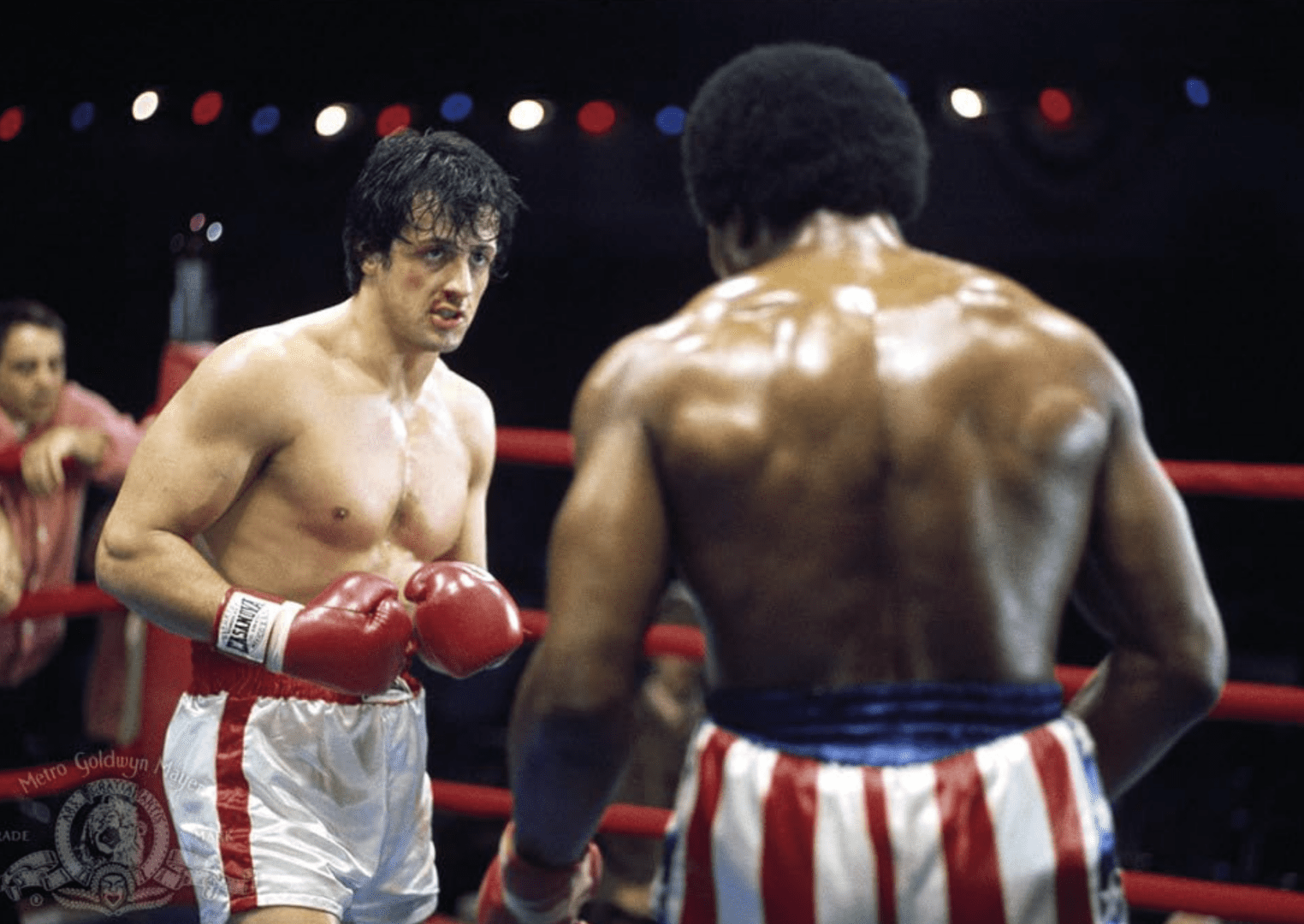
Rocky, for all its obvious theatrical excess, is perhaps the clearest example of this phenomenon. The fights themselves are borderline pantomime by Weir’s standards, the back-and-forth, the full spins, the clearly missed shots. But the scenes around them, the training, the relationships, the city, the desperate wanting, those all carry a truth that millions of people have responded to across decades.
“That’s what made a lot of people just love the Rocky and now Creed movies,” he says. “All these little scenes around the actual fighting. The buildup. The aftermath.”
The deeper question is whether a perfectly realistic fight film would even work. Whether, stripped of its theatrical shorthand and given back all the chaos and illegibility of an actual bout, it would hold a general audience at all.
Weir is thoughtful about this. He frames it as an impossible combination problem. “You don’t really get those two things occurring at the same time – like if only we could have a real fight occur with two professionals, whilst they’re also both amazing actors. You either have the sport itself and the real fight happening, where people who are movie enthusiasts aren’t as interested because it doesn’t have all the other aspects. And then you either have all those aspects, but then you just don’t get the real fight.”
It’s a tension that may be structural rather than solvable. The fight community, as Weir observes, is “quite niche, quite small” relative to cinema’s audience. Hollywood is not making films for people who can spot the angle on a cross. It is making them for people who feel something when the music swells and the underdog lands the shot that changes everything, regardless of whether that shot would actually drop a trained professional.
And there is something worth sitting with in that. Fighting is also not simply a sport.
It is, as Weir puts it, one of the most primal and philosophically loaded things a human being can do. “Philosophy involves questioning some of the most core and innate concepts in the universe. And fighting really is one of those things.” Survival, dominance, courage. Pain absorbed and pain given. “What’s the first thing animals do? They mate, they fight. They survive. That’s common across all animals.”
The spectacle of combat has always demanded enhancement with crowds, lights and ceremony. Look at the walkouts at any major modern fight, the pyrotechnics, the theatrical grandeur. Cinema is, in some sense, just the latest venue for that ancient impulse to dress fighting up, to add layers of meaning on top of something that, in its purest form, needs none.
“Why not have a cherry on when you’ve got the cake?” Weir says. “Let’s add flashing lights. Let’s add a big crowd. Because we just like to maximise these euphoric things.”
Hollywood, when it makes a fight film, is maximising. The chess match gets lost. The defence gets abandoned. The sound effects are exaggerated and the knockouts arrive too cleanly and the guards drop too conveniently. But the reason any of us watch a fighter walk to the ring at all – that part, it seems, cinema has always understood.
It just doesn’t always know what to do with it once the bell rings.