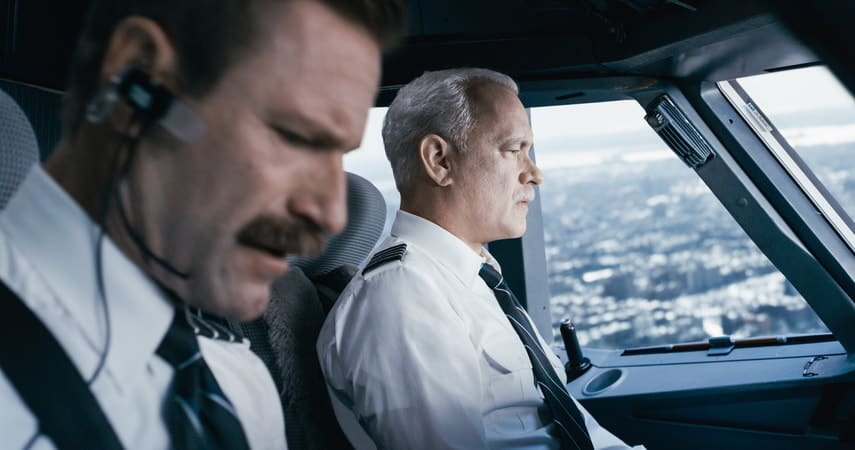
When Flight 1549 took off from LaGuardia Airport, Sully Sullenberger and Jeff Skiles thought it would be a regular flight to Seattle, with a planned intermediate stop in North Carolina.
Neither of them thought that they were about to lose both engines of their airplane at the lowest altitude ever in aviation history.
What Captain Sullenberger did that day defied all odds. It was a feat that took immense experience to have the awareness to ‘ditch’ the aeroplane in the safest place possible, the Hudson River.
In theory, the investigation from the National Transport Safety Board that was conducted after the crash concluded that Flight 1549 could have made it back to either LaGuardia or Teterboro airport. But at first, they didn’t take one factor into account.
“What we don’t practice for is what he had and therefore something called the startle effect kicks in, which is a human reaction and you can’t really train out of it.
“It’s something happening so out of the ordinary that you’ve never thought about, that it takes a little while for your mind to process it”, says Nicholas Stanger, a former Training Captain for Cranfield University and British Airways pilot.
“So when you related this to why didn’t they turn back to LaGuardia, which is initially what all the investigators said, it’s the fact that because the aeroplane’s moving at that point at three or four miles a minute, by the time they’d gone far enough, Sully didn’t think as captain of the aeroplane, that he hadn’t, by the time he could process what was going on.”
Stanger says that due to the startle effect kicking in, which takes 15 to 20 seconds to get through, there was no chance to return to either airport and therefore had to aim for the Hudson.
The actual flight time was five minutes and eight seconds. To put this into perspective, it’s the same time an average person takes to make a coffee, or the amount of time to read this article. That’s how quickly it all happened.
What took the engine out on the day was birds, and what hit Flight 1549 were migrating Canada Geese. Despite them hitting the engines, the author of ‘Cockpit Confidential’ and airline pilot Patrick Smith says it’s very uncommon for a bird to take out the engines, let alone two.
“It’s exceptionally uncommon. I mean, look at the numbers. How many times has it happened? I mean, it’s once.
“There was a military plane in Alaska that crashed from bird strikes, taking out, I think, all four of its engines. I think that was back in the 80s. There was a crash in the 1960s involving a plane where two of its four engines were taken out by Birch. So now we’re going back already 50, 60 years to find one.
“When you consider how many millions of airplane flights there have been in that interim, the numbers are just astronomically low. You can’t even imagine how unlucky that would be.”
Due to the Geese migrating from the far Canadian Arctic, there was a much larger amount of them than your standard bird strike, and furthermore they average a weight of 3.5kg each, roughly double the weight that jet engines are typically designed to safely withstand.
All major airports usually have bird scarers to scare them away, and therefore as your first departing it’s very rare as you’ve usually scared them away. However Stanger says: “You do tend to have bird strikes within three or four miles of the airport where they are not scaring them away and you’re still low enough down to be in the same area, same sorts of height above the ground that birds flying.”
Stanger, who has over 30 years of flying experience estimates that 1 in every 100 airplanes have a bird strike, but quickly points out that they usually occur at an average of 35,000 feet, not 2,800 feet, or roughly 850 metres.
At 35,000 feet you usually have time to restart the engines, and this process takes an average of 30 seconds. Landing on water is also a process pilots rain for, and this is part of the ‘ditching’ procedure.
For Sully and Skiles, their best bet was to go for the Hudson, and it was one of the greatest decisions in aviation history, saving 150 passengers and 5 crew.