When Anthony Hopkins broke down at a poolside in One Life, he was channelling something most people never saw in Sir Nicholas Winton himself. The man who saved 669 children from Nazi-occupied Czechoslovakia didn’t do emotion. But the story his daughter spent decades trying to tell and the film it ultimately became, has made the rest of us do it for him.
There is a version of this story that begins with a wife wandering through a cobweb-filled attic. She stumbles upon a suitcase. Inside is a scrapbook containing the secret of a lifetime.
It’s a good story. Clean, cinematic and ready-made for a screenplay. Yet it is, according to Steve Watson, not entirely true.
“We don’t like the truth to get in the way of a good story,” Watson says with a laugh that carries a great affection. Watson was married to Barbara Winton, Sir Nicholas Winton’s daughter, until her death in 2022, and is now a trustee of the Nicholas Winton Memorial Trust. He helped Barbara research and write the book that One Life (2023) is based on, and he has spent the better part of four decades watching Nicky’s story accumulate layers of mythology.
“The attic in their house in Maidenhead was about three feet tall,” he says. “It was a relatively modern house. I’ve been up in it, and believe me, you can’t stand up in it.”
The image of Grete Winton picking through hanging cobwebs and shadows is a filmmaker’s dream. The truth, Watson insists, is quieter, more human and the story was known to those close to Nicky long before the famous 1988 That’s Life broadcast brought it to a national audience. “I knew about it from Barbara and from friends of Barbara in the seventies. Nicky had even mentioned it in a little bio he wrote when he stood for a local council seat. It wasn’t a secret. It certainly wasn’t well known. But those are different things.”
This distinction between a secret and something simply unacknowledged matters a great deal to the people who were closest to Nicholas Winton. And it also matters a great deal for understanding what One Life is actually doing, beyond the moving performances and the dual timeline structure that cuts between Johnny Flynn’s urgent 1938 Prague and Anthony Hopkins’s sombre 1988 Maidenhead.
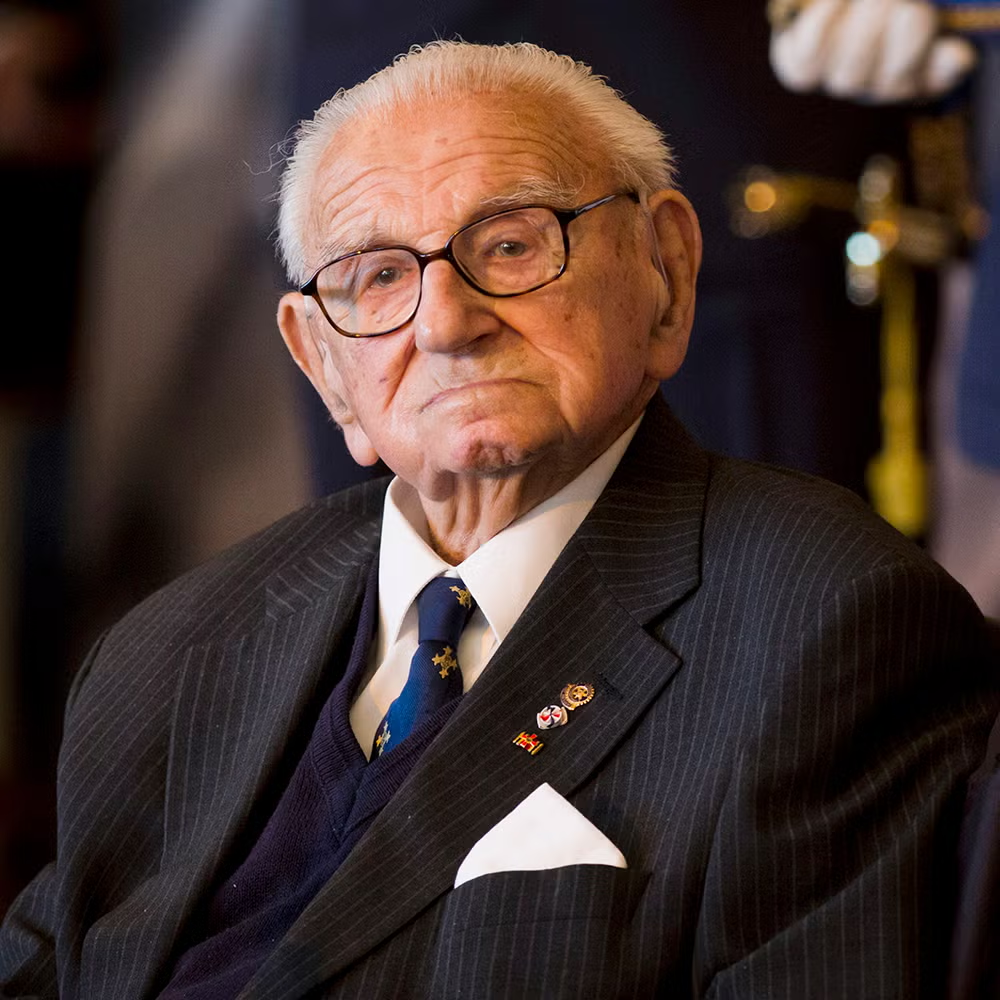
Before there was a film, there was a scrapbook and before there was even a story to tell, there was the British Committee for Refugees from Czechoslovakia. The BCRC had been formed in October 1938, and its Prague office was being run by Doreen Warriner, a British economist who had been organising relief efforts for political refugees since before Winton arrived. It was Warriner who introduced the 29-year-old stockbroker to the reality of the refugee camps and it was Warriner’s network that gave his operation its first proper standing.
The film, to its credit, does not sideline her. Romola Garai plays Warriner as exhausted, principled, and faintly exasperated by the energetic young man inserting himself into her operation.
What Winton managed to build was the British Committee for Refugees from Czechoslovakia, Children’s Section. Its membership was made up of himself, his mother Babette, and a handful of volunteers. To ensure its credibility with both the British Home Office and the Nazi authorities whose territory needed navigating, he operated it as if it was a huge institution. The film captures this well in the Home Office scenes and the scramble for permits and foster families.
“There was resistance from various organisations saying, you’re going to complicate the issue,” Watson recalls. “And Nicky was resistant to those pressures. He simply pushed ahead because he recognised the urgency. I think that’s the crux of it.”
Between March and August 1939, eight trains departed Prague carrying predominantly Jewish children to Liverpool Street station. The ninth, scheduled for 1 September, the day Germany invaded Poland, never left. The 250 children whose places on it had been arranged were, in almost every case, murdered. That failure haunted Winton for the rest of his 106-year life in a way that his rescue of 669 never seemed to comfort him.
The scrapbook that sits at the centre of One Life was assembled by a fellow volunteer, who presented it to Sir Nicholas at the end of the Kindertransport operation as a record of what they had done. It contained transport lists, photographs, maps, and letters from parents who had handed their children to strangers at a railway platform, unsure they would ever see them again.
In 1989, Winton donated it to Yad Vashem, the World Holocaust Remembrance Centre in Jerusalem. The trust still holds copies today, and one in particular that Watson calls “the Maxwell copy,” which is a black-and-white photographic reproduction made by Robert Maxwell.
“The scrapbook was the heart and soul of the whole story, essentially,” Watson says. “We have very little material from 1939. The people in Prague destroyed the documentation, you see them throwing the stuff out of the window in the film. That was a pretty vital move to prevent the Nazis getting hold of those lists and persecuting the people who remained.”
Watson describes going through the scrapbook material with Barbara and stumbling upon an element of the story that Winton himself had considered incidental. Nicky had been involved in transporting Nazi-looted gold, and the scrapbook contained photographs of chests filled with what were clearly gold teeth.
“He once said he had a million gold rings in his possession. And that’s pretty heartbreaking, if you think about the six million people who were murdered, and how many of them had gold rings. A million gold rings. That kind of adds up. That was pretty shocking, really.”
What also moved Watson and Barbara in the research was the dawning realisation of how much the survivors needed to understand their own rescue. “I don’t think Nicky really realised how important it was to those survivors to find out their own story. How they’d been rescued, who rescued them, what were the circumstances. I don’t think any of us really understood how important that was. And so when all those people started appearing, all the tears started to flow.”
Barbara Winton always wanted Anthony Hopkins to play the older Nicky and when he was initially approached, Hopkins agreed. Then COVID intervened and there were directorial changes. Then came the Russian invasion of Ukraine.
“We had a massive influx of refugees,” Watson says. “I had one Ukrainian lady helping me here, in fact. And I think Hopkins took that on board. He said it to be one of the reasons he decided to do it, that he was moved by the plight of all these people who suddenly came under attack.”
Watson recalls that the production company kept in contact with the Winton family throughout development. Helena Bonham Carter, who played Babette Winton, Nicky’s mother, who co-ran the London end of the operation, telephoned Barbara directly to talk about the woman she was playing. “Barbara was very ill at the time. She hadn’t got many months to live, I think, when that call came through. So it was rather wonderful for her to get that direct contact.”
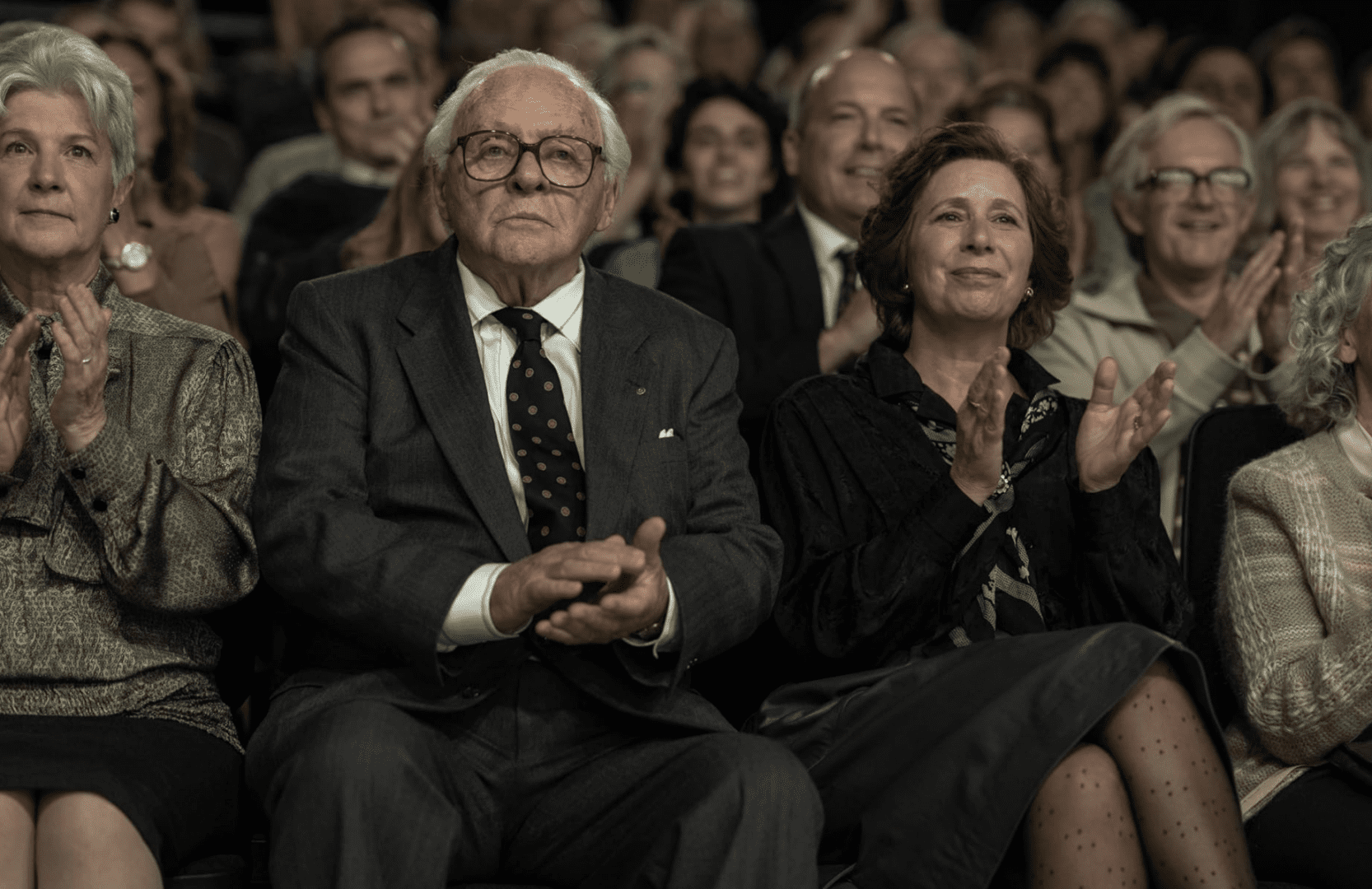
Watson’s own children, Nicky’s grandchildren, were even cast as extras in the finale, the famous That’s Life scene where the audience of survivors stands to acknowledge their rescuer.
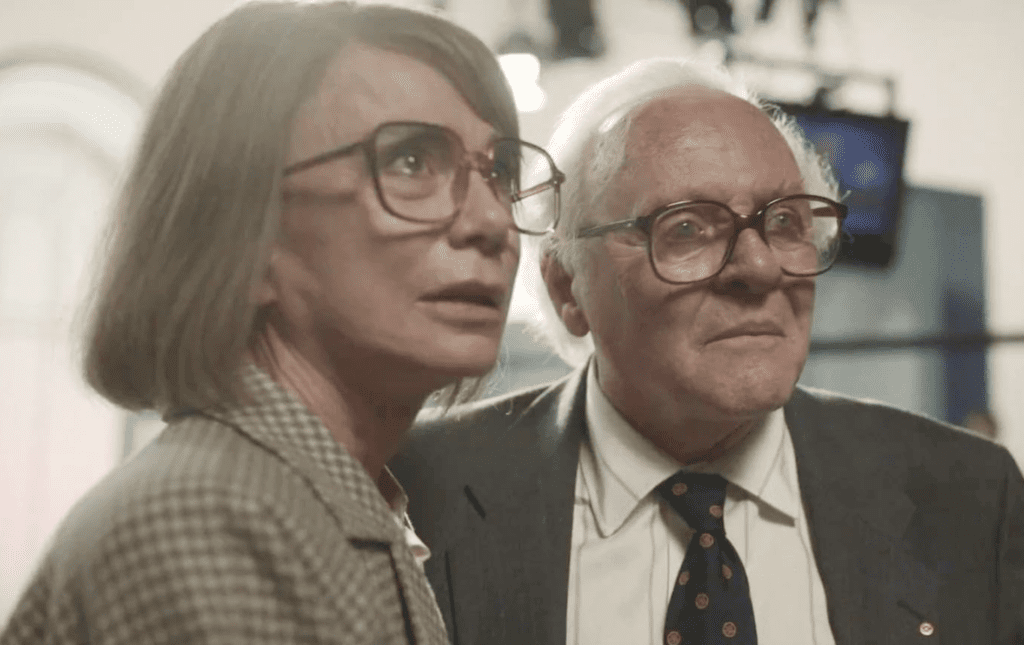
Hopkins, Watson says, achieved something pretty special, “His voice has sort of become Nicky’s voice. I’ve seen the film so many times now, and I’m still in tears in the first couple of minutes. The scene where he breaks down by the pool was an interpretation of Nicky’s hidden emotional life, which you would never see. He was an old-fashioned English gentleman. He didn’t betray his emotions.”
The film has brought Winton’s story to a global audience in a way that no book, documentary, or television broadcast had previously managed. But for Watson and the Nicholas Winton Memorial Trust, the work is not done yet.
“We have very few documents from 1939,” Watson acknowledges. “But we have a large amount of documentation from the rest of his life like a vast number of awards, personal letters, correspondence from Dunkirk. He was rescued twice from the coast of France while driving an ambulance. These are extraordinary stories that have nothing to do with the Kindertransport.” The trust is in conversation with the Imperial War Museum, Watson says, about the possibility of housing the collection somewhere with the resources and the reach to make it properly accessible. “We want to document it, preserve it, and make it available to researchers online.”
The Wikipedia entry for Winton, Watson notes, is constantly chopped and changed back toward the more dramatic mythology. “Whenever I try to put it right, someone else puts it back.”
For younger audiences encountering the story through the film, Watson hopes they take away something simpler than all of this. Winton attended events for Czech schoolchildren, he says, where the message was always straightforward, “That you can make a difference. That small, everyday actions whether you’re helping your old neighbour get a newspaper or whatever, those small actions add up. They do make a difference.”
Watson also said Sir Nicholas had a particular relationship with rules. “If there was a sign saying don’t walk across the grass, he always translated that as walk across the grass.” He paused, “He did believe in going against the odds. He was a very moral man. But there are times when one needs to stand up and be counted. Don’t be afraid to do something, just get on with it, and don’t look for reward. Doing this kind of work is its own reward.”
When all is said and done, the movie has a simple message. One life. Then another. Then 669. Then over six thousand descendants. Then a book. Then a film. Then the rest of us, sitting in the dark, crying and perhaps doing something about it afterwards.