Our rating
Josie Rourke’s Mary Queen of Scots is the third major Hollywood adaptation of Mary Stuart’s life, and yet a truly accurate portrayal of the famed monarch remains elusive on the screen.
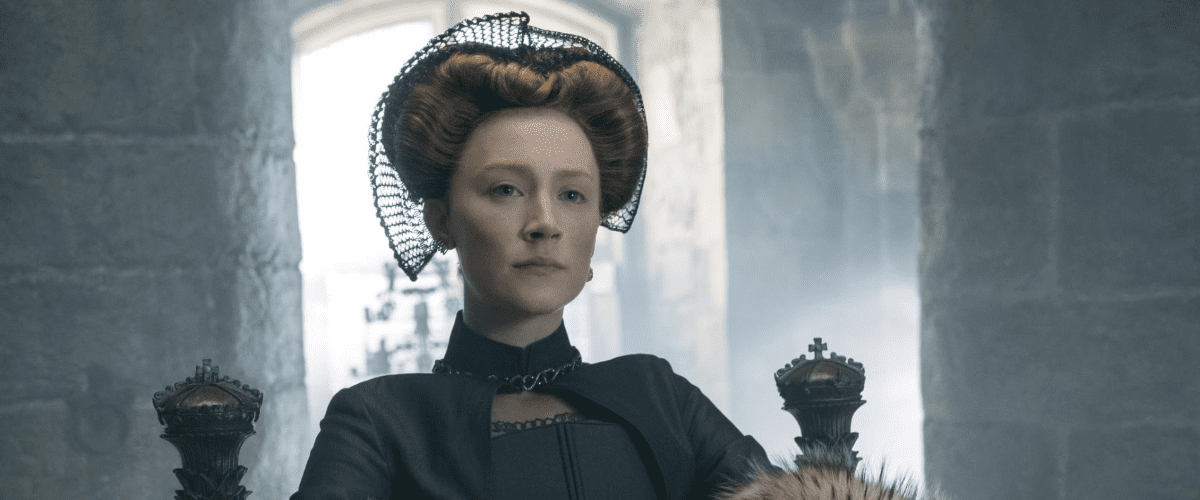
Previously played by Katherine Hepburn in 1936 and Vanessa Redgrave in 1971, Saoirse Ronan takes the crown in the 2018 adaptation of John Guy’s biography – Queen of Scots: The True Life of Mary Stuart.
Ronan herself gives a noble performance as the embattled queen, though she adopts a Scottish accent rather than Mary’s native French, effectively depicting Mary’s struggle to maintain the Scottish throne amidst deep internal religious divisions.
Mary’s marriage to Lord Darnley (Jack Lowden) is dragged out to dramatic exhaustion, with tedious scenes of their tumultuous relationship given priority. Whilst perhaps accurate in the details of Darnley’s character, and with the finer details of the murder of Mary’s private secretary, David Rizzio, this comes at the expense of dramatic propulsion and means that Mary’s later marriage to the Earl of Bothwell (Martin Compston) is far too rushed.
The centrepiece to the narrative is the relationship between Mary and her cousin south of the border, Elizabeth I (Margot Robbie). In reality, the two enjoyed a cordial relationship through letters, but this is where the film takes its greatest liberties with the history books.
The two monarchs never met, yet the dramatic climax of the film is a heavily built-up confrontation between the two upon Mary’s arrival in England in 1568, in which Elizabeth is portrayed as vulnerable and fragile, rather than as the woman who would imprison Mary for nineteen years before her eventual execution in 1587.
What Mary Queen of Scots‘ gets right in reflecting the history books makes the film tired and without dramatic tension, whilst the sheer magnitude of its standout scene ensures that there is yet to be a truly accurate depiction of Mary Stuart.