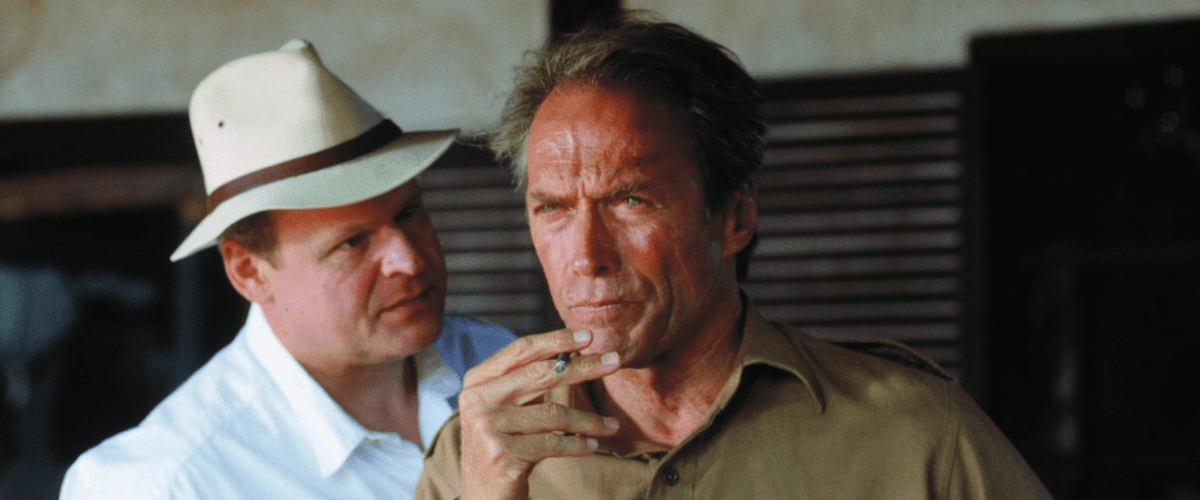
Film historian Max Alvarez discusses Clint Eastwood’s White Hunter Black Heart (1990) and his portrayal of legendary filmmaker John Huston.
Based on screenwriter Peter Viertel’s novel, the film depicts a fictionalised parallel to his experience working with director John Huston on the production of 1951’s The African Queen.
Alvarez said: “The film White Hunter Black Heart is about a director who’s trying to live up to his macho Hemingway-esque image, and ultimately can’t. I think that is the main theme, and I think that’s what attracted Eastwood to the project.”
Clint Eastwood embodies John Wilson, a thinly-veiled caricature of Huston, who leads a fictionalised film-crew astray through his infatuation with big-game hunting.
Eastwood became involved in the production through the then-incomplete Orson Welles film The Other Side of the Wind (2018) which starred John Huston in the lead.
Alvarez said: “He was fascinated because John Huston was in The Other Side of the Wind. So he studied a lot of the footage of Houston in that Welles film for his performance.”
In real-life Huston was famed for his eccentric lifestyle which included portrait-painting, horseback-riding and hunting.
At the climax of the film, Eastwood’s Wilson comes face to face with his prey, an African tusked elephant.
“As I was watching the film, my takeaway was that the Huston character in White Hunter Black Heart ultimately can’t kill that elephant. I think that’s when he’s starting to get in touch with more humanity of his character. And he’s starting to realize perhaps the injustice of what he is trying to do.
“I believe there’s an element of truth to that because, seven years later Huston made a film, The Roots of Heaven (1958), which was ahead of its time. It deals with the brutality of sportsmen going to Africa to kill elephants.
“I have to believe there was a transition in Huston’s beliefs from the African Queen experience.”
White Hunter Black Heart was a commercial failure, only recouping $2million of its $24million budget at the box office.
“White Hunter Black Heart really affected Eastwood’s relationship with Warner Brothers, it set him back in terms of the clout that he had at the studio.
“The failure of the film hurt his influence.”