Cinema is obsessed with the same moments throughout history. We looked to find out why, and what this means for the future of storytelling.
From the nauseating scale and frenetic atmosphere of WW2, to the eccentric politics of Ancient Rome, or the soft-spoken eloquence of Tudor England, it seems that the entertainment industry is stuck in a historical loop, where tried and tested formulae depicting certain eras is repeated, over and over again.
With the spotlight consistently shone on the same periods of time, there’s less to go around for others. In a study from Stephen Follows, analysing the time period of over 17,000 movies, he found that 11.5% of non-contemperaneous (movies set in a different year to the one they released) were set in the 1940s, which is more than any other decade or recognisable time period.
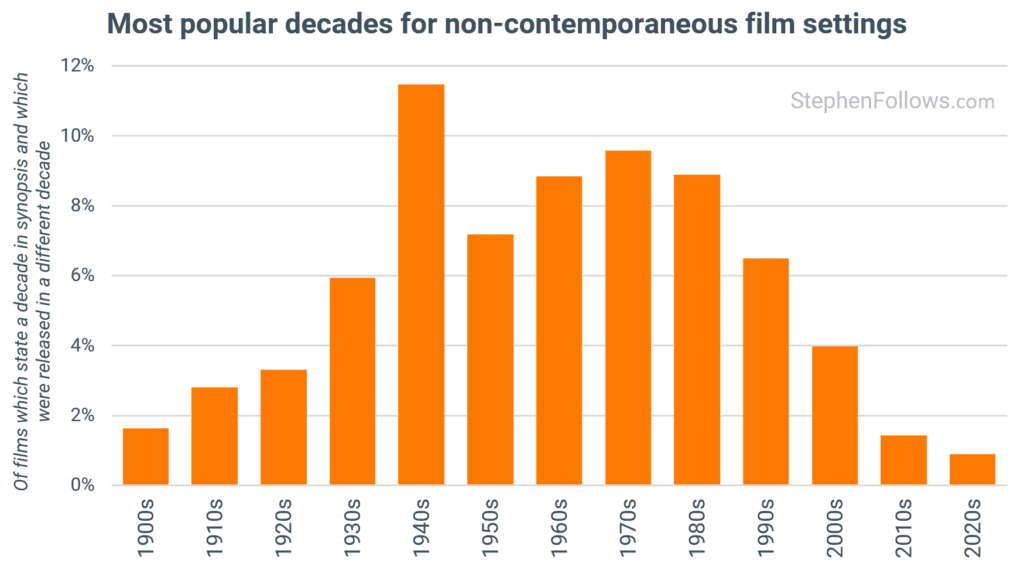
Whether it’s due to existing filmmaking infrastructure, audience familiarity or in some cases, award prospects, some eras recur frequently, while others are neglected and left largely unexplored. So what is it about these periods that are so frequently returned to, so carefully polished, that keeps them alive on screen while others remain mostly unseen?
“There’s obviously a nostalgia there, it’s quite easy for people to recognise certain periods because certain periods have such a distinct look, and that can be comforting for audiences,”
says Faye Picknell, a London based costume and crowd assistant. Some historical periods persist not because they are more important, but because they are more immediately recognisable.
From togas and larger than life jewellery, to a fabric accurate military uniform accompanied with an authentic “pack of smokes”, these costumes have been reproduced, revised and refined almost universally, offering audiences an easy entry point into the past.
She went on to say: “It’s not just in the clothing, it’s things like colour pallets as well, if you want to show a specific time and for that to be recognised. For example, the seventies and eighties looking at yellows, oranges, browns. It’s about making sure everything fits how it’s meant to fit.
“When audiences can see portions of their own lives on the silver screen, or even memories of what the silver screen looked like in their lives, entertainment has a way of generating nostalgia and the feelings of those times in people in a way not many other things can. So it’s no wonder that filmmakers consistently attempt to recreate that, not just simply in crafting movies and television set in the same era, but recreating the same schema, visual cues and the artistic choices that come with it.
“The bigger the budget, the more amazing things you can do.”
“There is definitely a savvy way to do things,” Picknell says, “People almost always get more creative with a smaller budget, but it’s definitely a lot harder.”
The economics of filmmaking contribute to the aforementioned ‘historical loop’ we’ve seen dominate screens for decades, it’s not just formed through viewer preference or cultural nostalgia.
Studios feel financially safer with projects that have already been covered because they know it will land with audiences, at least to some extent because it already has.
The practicality of production reinforces the cyclical nature of cinema. Existing infrastructure including extensive archives, research projects and the sheer amount of historical experts willing to lend their expertise to productions all play a role in why filmmakers return to certain eras. It’s not just the budget alone, but it does help.
“With a bigger budget you just get more freedom. You can go to these amazing hire houses with thousands of screen-ready costumes. On one project we had a WW2 military expert in with us, who after a day on set was able to tell us to change the camouflage pattern that we had been using in order to make it historically accurate. That’s the kind of expertise available in those eras that have been covered vastly already,” Picknell explains.
Patterns exist, suppliers are familiar, and audiences already understand what they are seeing, culminating in the common on-screen eras proving to be less stressful when preparing for production.
Though sets and costumes root the visual framework and ambience of a movie or tv show in a point in history, it is actors who animate these stories and bring the history to life.
When they begin acting, history is no longer some inanimate construct, it’s real, and happening. Historical roles have their challenges, as upcoming London-based actor Amelia May says, “It’s difficult trying to stand out when you’ve got a role in an era that’s been on screen so many times.
“But also it means there’s so much tape out there to draw inspiration from. Finding a balance between the two is really important.”
Accents, gestures and behavioural patterns are often inherited for actors, rather than having to be learnt. It can sometimes feel innate, again culminating in a sense of comfort when revisiting eras that have been seen so many times.
“The critical attention and focus on historical roles has been undeniable recently,” explains May.
“There’s no question. They can be a great way to show your craft as they often require having to adopt period typical mannerisms, dialect and movement. Period pieces are also often associated with prestigious literature, which heightens their acclaim for awards, and show characters who lived during times of extreme emotional, social and political duress, which provides a base for an emotionally high stakes performance that award committees always like. ”
Critical acclaim has undoubtedly followed historical roles in the recent past. From Margot Robbie’s role as Tonya Harding in I, Tonya (2017) , to Cillian Murphy as J. Robert Oppenheimer in Oppenheimer (2023) and even Timothée Chalamet as Bob Dylan in A Complete Unknown, (2024) all these actors achieved serious critical recognition, so the incentive from an actor’s standpoint to take these historical roles, has perhaps never been greater.
Recent years have seen increased interest in stories that challenge traditional historical narratives, yet these remain exceptions rather than the rule.
Ravi Astley, a young film fanatic based in London says “It’s a self-sustaining cycle, whereby the people in charge of the mega productions, are more often than not white, so the movies and in this case historical movies, are focused on white history.
“I’m not saying it’s the sole reason and maybe it’s not so much today, but it’s definitely the case for film in the 20th century.”
The 2025 edition of UCLA’s Hollywood Diversity report, published Tuesday, found that of the top 250 most-viewed current and library scripted series in 2024, more than 91.7% were created by a white person, with white men accounting for 79% of all show creators.
The statistics paint an interesting picture.
“I get that some of these guys, they believe some stories, and histories might be too controversial or too politically charged to be in the mainstream Hollywood space, but even if that belief was true, that doesn’t mean they should be ignored altogether,” Astley says.
May herself says she “would love to see more historical pieces that represent non Western-centred history,” but truthful stories from non-Western cultures or from women, working-class communities and people of colour can often be seen relegated to the margins, if they even appear at all.
Hollywood studios follow their longstanding assumptions about what audiences want to see and their assumptions about what will make them money.
The danger with this is that with cinema being one of the most powerful forms of storytelling in the world, certainly the most digestible, is that it can lead not only to the exclusion of eras but the distortion of history itself.
Cinema as we see it today, remains in a historical loop, where the same times are revisited and though stories are rewritten, mostly exist within the same contexts. The eras we see on screen are the reflection of a network built to sustain itself year on year, from the comfort and familiarity of the bonds created in production, to the trust and familiarity of audiences, largely satisfied by the final products.
These eras are not necessarily exhausted, but as audiences grow more aware of the repetitive nature of the business, now is the time to shift narratives.
History is not owned by a single perspective, it shapes and is shaped by so many lives that don’t appear on the big screen.
So if historical storytelling through film is to advance and become more accurate and inclusive, it must become an open playing field, one that welcomes new voices, new perspectives and a new way of seeing what has always been there.