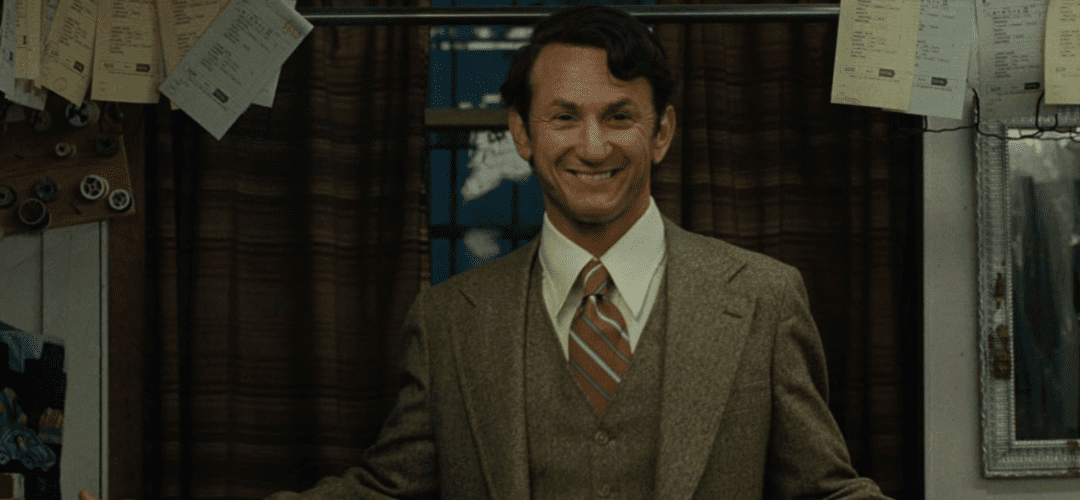
Thirty years after Harvey Milk’s tragic assassination, a Hollywood production set out to rebuild his revolution on the very pavements he once walked. Milk’s friend Danny Nicoletta and actor Lucas Grabeel look back on the reality of Castro Cameras, its recreation and the figures omitted from the final cut.
The image of Harvey Milk has changed over the years. To those who lived through the 1970s, especially in Milk’s native San Francisco, he was a larger-than-life figure, whose wide, toothy grin, mess of dark hair and large protruding ears made him stand out from the crowd. Even more so when he was atop a soapbox, his voice amplified by a megaphone, spreading a message of hope and unity to America’s LGBT community in their struggle for civil rights. In the years since his assassination in 1978, he became a martyr, his image deeply ingrained in the gay civil rights movement. But that image faded. To modern audiences and to those around the globe who did not know Harvey Milk, his face is that of Sean Penn.
In Gus Van Sant’s Milk (2008), the distance between film and history was intentionally collapsed, with every emphasis made to make the film as true to life as possible. The pavements in which it was filmed were the same that Harvey Milk had walked down thirty years earlier, real figures in his life were involved in the filming process, and a deep historical immersion was required of the actors involved. The production did not merely base itself on a true story so much as attempt a cinematic exhumation, inviting the ghosts of the Castro to step in front of a camera and to reawaken Harvey Milk’s legacy.
Setting the Scene – The Castro
In August 1974, a nineteen and a half year old film student named Danny Nicoletta walked into a cramped shop in the Castro district of San Francisco called Castro Cameras. At the time, he had no idea what he was walking into; he just needed a place to develop his Super 8 films. Instead, he found a community.
“Everybody would go in there and sit on that old stuffy chair and just shoot the shit with the guys,” Nicoletta recalls of his time spent at the camera shop owned by Milk and his then partner, Scott Smith. These were the days before Harvey Milk became a public figure, when he was just another member of the booming “gay ghetto” of the Castro.
“I thought they were great, they were very exuberant about me, they took a personal interest in my work right away, and we would talk art and work,” Nicoletta remembers. After a year or so of hanging around at the camera shop, Nicoletta was offered a job in the camera store to accommodate Milk’s growing political career.
“It was real seat of the pants stuff”, he says, “we’re sitting there, and Harvey and Scott are in their jeans and people are passing joints and whatever, we don’t have the sense of the gravity of it at that point.”
This wasn’t just a retail space; it became a community hotspot. Nicoletta describes a “constellation” of activists, poets, and filmmakers, a “coffee clutch”, who founded Frameline, the world’s biggest LGBTQ+ film festival.
“We had everybody squeezed in there like a tuna can, and there was a Super 8 projector in the middle of the room and a little bed sheet at the end of the room. So it was super DIY. Then, there was Harvey in the middle of it all – he came to support me and see my film.”
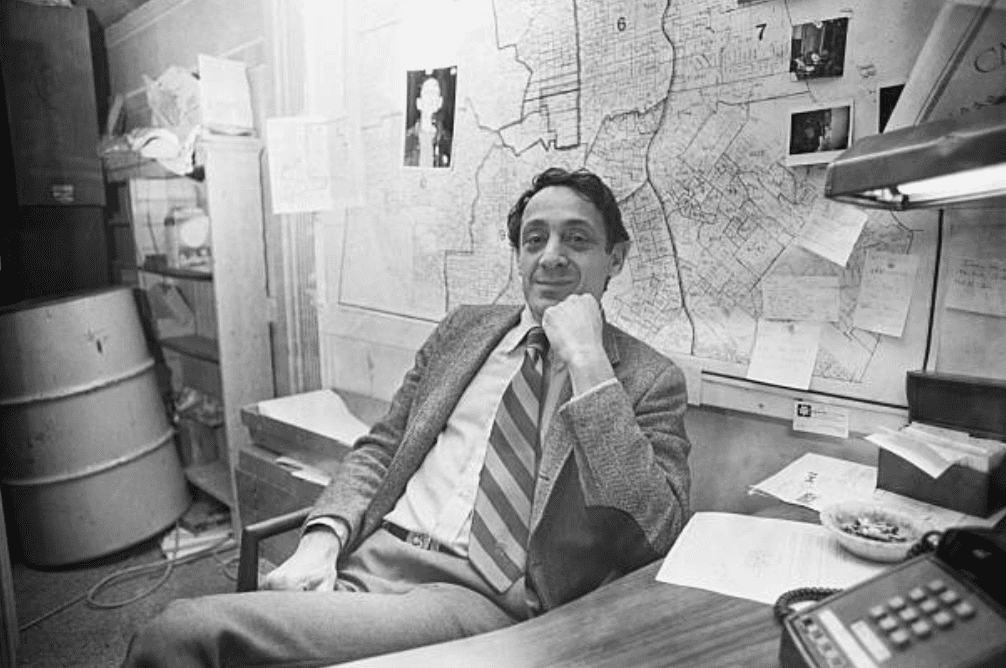
However, the looseness of the shop began to tighten as the mid 1970s progressed. The mild-mannered man behind the counter was transforming into a serious political candidate in San Francisco. Driven by the backdrop of Anita Bryant, a former Miss America runner-up, evangelist, and orange juice spokesperson, establishing an anti-gay rights “Save Our Children” campaign in Florida, Harvey Milk became more tenacious than ever in his fight to get elected to the San Francisco Board of Supervisors. Bryant’s campaign framed the burgeoning gay rights movement as a moral contagion, and her success in repealing a pro-gay ordinance in Dade County sent shockwaves through the Castro and wider gay community in America.
“Harvey was hated, and we got a lot of hate mail,” Nicoletta remembers. Bryant’s crusade provided the “common enemy” that Milk needed to galvanise a disjointed community. It turned the camera shop into a political fortress and its workers into overnight activists. It was a transition that Nicoletta captured through his own lens, serving as the central archivist for the development of Harvey Milk’s political ambition.
Bringing the Castro back to life
Fast forward thirty years to a winter morning in 2008 and the Castro district was once again draped in the aesthetics of the seventies. There were bell-bottoms, film canisters and no shortage of “Milk for Supervisor” posters. This time the “tuna can” camera shop was a Hollywood set, and the man behind the counter was Lucas Grabeel.
At the time Grabeel was a global teen icon, one of the leads of the High School Musical franchise and adored by millions across the globe. He was accustomed to the polished sets of family-friendly entertainment, where every hair was sprayed into place and every line was delivered with added gloss. Stepping into the shoes of Danny Nicoletta was not just a professional pivot, it was an entry into a “well-oiled machine that felt like [they] were bringing the Castro back to life.”
“I’ve always held Milk as such a pinnacle moment in my career”, Grabeel reflects, “I still to this day look back and this, how did that happen? How did the kid from High School Musical get on such a prestigious and important film?”
The answer lay in director Gus Van Sant’s pursuit of a raw, “documentary-style realism”. To bridge the thirty-year gap, Van Sant wanted to resurrect the Castro as truly as possible.
The art department, struggling to visualise the cramped interior of Castro Camera, turned to Nicoletta’s personal archives for help: “They were really struggling with the interior of the camera store, and I happen to have like two or three colour slides that were just kind of seat of the pants shots. They weren’t arty at all. And when I was like, well, here’s these and you can see the colouring of the walls, and you can see these various things that were hanging on the walls.”
“The vest that Lucas is wearing is actually my real vest,” Nicoletta says with pride, “You couldn’t get that thing off my back in the day.”
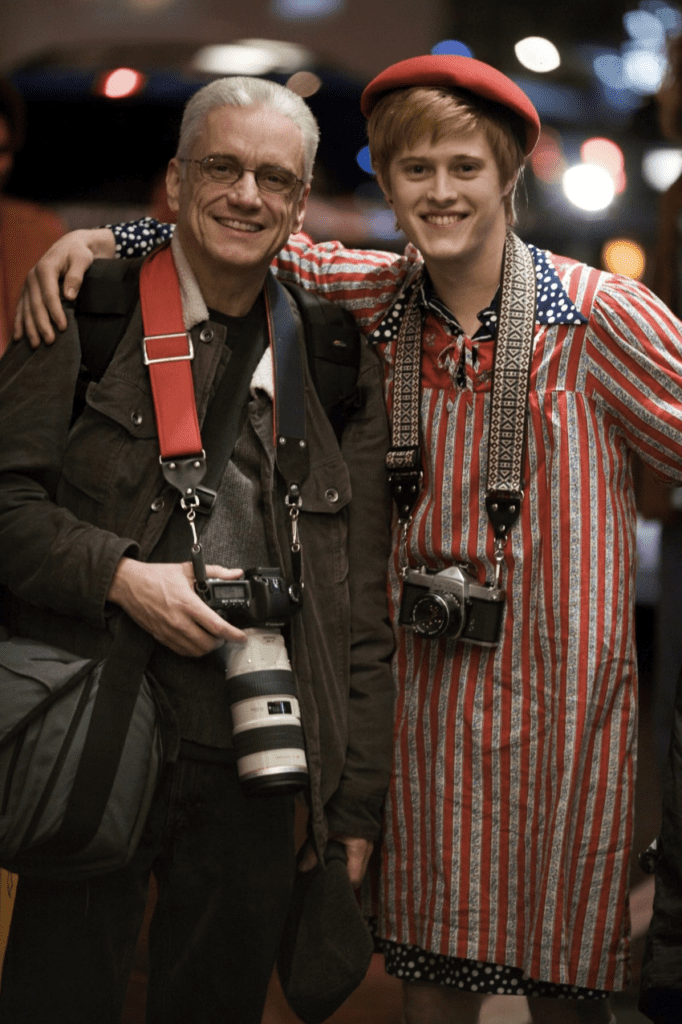
For the actors, these objects were more than props; they were totems of security that allowed them to properly be anchored to the historical Castro.
“Gus handed out newspapers from 1974, a collage of articles from a certain week in time. And he’s like all right, take a few minutes and read what’s been going on in the city at that time, because it’s really important that we create this energy in the camera shop.
“Then he goes ‘make this a day in the lives of all of you guys’. So we’re laughing, were joking around, we’re bickering about politics. All these things we’re creating that I had never done before”, Grabeel says.
For Grabeel, coming from the highly structured world of musical theatre, this freedom was a revelation. It wasn’t about “playing pretend”, it was about creating the space with the same DIY energy that Nicoletta remembered from 1974. This immersion prepared the young cast for the arrival of the production’s gravity – the total transformation of Sean Penn into Harvey Milk.
Sean Penn as Harvey Milk
The atmosphere of the set was dictated by Sean Penn’s total immersion into the role, for which he was awarded an Academy Award. For the younger cast, Penn wasn’t just a co-star; he was a mirror to the historical Milk, a man who was able to command hostile rooms by sheer force of personality. Lucas Grabeel recalls a cast dinner early in production that served as a chilling introduction to Penn and his energy on-set:
“He had the fucking balls to just walk through an entire restaurant smoking. He has such a presence. He is a commanding force, and he’s very quiet, which I guess is a lot like Harvey, which just adds this intimidation level.”
But for Nicoletta, Penn’s involvement was a more complex calculation. It wasn’t just about the acting, but more the attitude that Penn was able to reflect.
“I think that Sean was a good choice because of the DIY spirit of the thing… he’s a maverick you know, you can’t split hairs on the actual portrayal.
“He has so much prowess as an actor in terms of controlling results that it’s his project at the end of the day. It’s produced by Focus Features, and it’s Gus and Lance, but nothing happens unless Sean wants it to.”
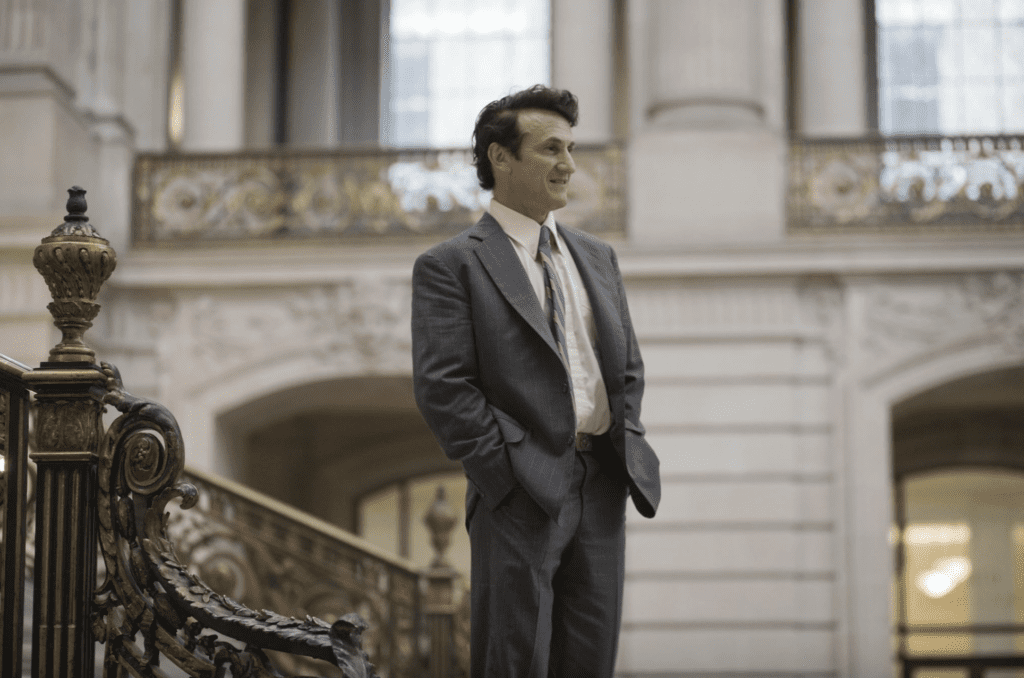
The “maverick” dynamic of Penn, immersing himself into the character through method acting off set, with a total commitment to historical research that Grabeel notes, helps the film feel so visceral, even if it meant sacrificing a similarity with regard to the image of Harvey Milk.
As Nicoletta notes, had the producers cast an actor like Daniel Day-Lewis, who had been considered, the result might have been “more Hollywood polished,” but it would have lacked the grit of the original movement. Penn’s presence ensured that the film maintained a jagged edge, turning the production into a mirror to the struggle it sought to depict.
Missing Figures
However, while Milk captures the political triumph, it largely sanitises the physical terror of the era, specifically the murder of Robert Hillsborough. In June 1977, Hillsborough, a city gardener, was stabbed fifteen times by attackers as they shouted homophobic slurs. His death was a cultural watershed that triggered the famous whistle campaign, which is alluded to in the film.
On the omission of Hillsborough’s death from Milk, Nicoletta notes that “they actually shot a lot of this narrative and it didn’t make it into the final cut”, as it was felt that it took away from the momentum of Harvey Milk’s journey, and was too big a diversion from the individual story.
This prioritisation of Harvey Milk’s singular story also resulted in the erasure of Sally Gearhart, a central figure in the lesbian community who appeared alongside Harvey Milk in debates across California against John Briggs in their opposition to the controversial Proposition 6 initiative, which sought to ban gay men and lesbians from working in public schools. Her role was largely aggregated into the character of Harvey Milk’s campaign manager, Anne Kronenberg, who acts as the film’s sole representation of lesbianism.
“The complaint that a lot of people, particularly the lesbian community, had was ‘Where’s Sally?’” Nicoletta says. “I think the reasonable argument on the filmmakers’ side would be that they’d have had to develop a fully fleshed out character, but that’s no excuse ultimately.”
The Transfer of Hope
Despite the gaps in the cinematic record, the reconstruction of the Castro served as a bridge between two eras. For Danny Nicoletta, the film was a high point in the “ebbs and flows” of preserving Harvey Milk’s legacy, an occasion which brought the name back into the cultural spotlight after years in the wilderness.
For Lucas Grabeel, the experience of stepping into that history was a chance to explore sides of himself as an actor that were previously unexplored, while also offering hope – “it’s a beautiful love story, and it’s a story about hope and inspiration,” he concludes.
The resurrection of the Castro and those faces that haunted it in the heyday of California’s gay rights movement in the 1970s brought the name Harvey Milk to global audiences, continuing the legacy that Nicoletta and others have fought so hard to preserve in the years since his assassination. Whilst Harvey Milk’s face may now be more associated with that of Sean Penn’s, perhaps that is core to the ‘transfer of hope’ that Harvey Milk spoke of, that whilst Harvey Milk may be gone, his story will be eternal.