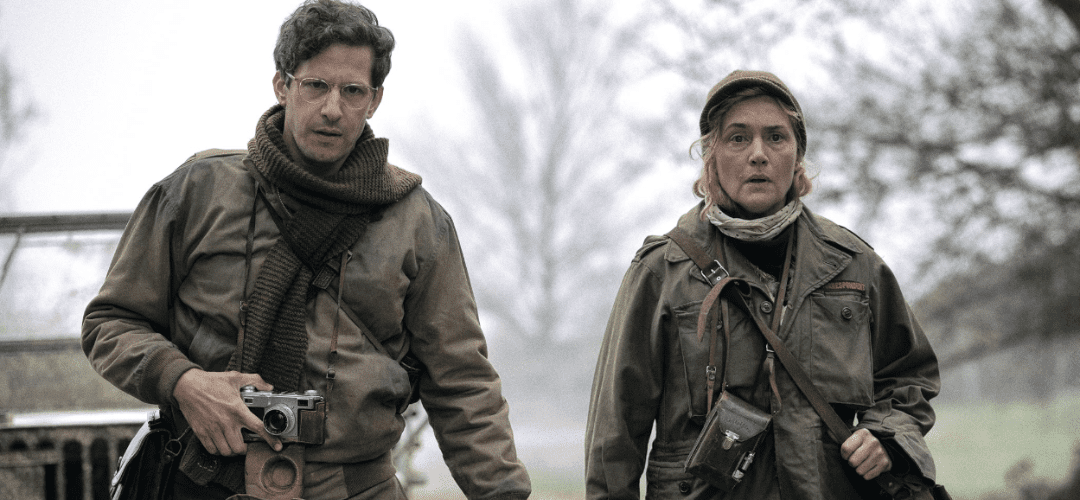
Lee Miller became the first female war photographer to be stationed alongside an infantry unit during the Second World War, The film Lee depicts her fight to get to the frontlines and the truth behind her most enduring photographs. Her son, Antony Penrose, discusses the importance of telling her story as accurately as possible, and how working alongside Kate Winslet brought him closer to the side of his mother’s life he never got the chance to ask her about.
Antony Penrose knew next to nothing about his mother, Lee Miller’s life before he was born, in his own words, he had “dismissed her as being a useless drunk who’d achieved nothing,” he says.
It wasn’t until after his mother’s death in 1977 that his outlook on the woman he thought he knew changed the course of his life, when he stumbled upon an enormous archive of 60,000 negatives, manuscripts and other souvenirs she had taken from her time as Vogue’s war photographer during the Second World War.
“It turned out to be a life-changing experience, it was deeply emotional. Suddenly there was this incredible record of journalism. How wrong can you get it?” Penrose says.
While his father, Roland Penrose, had known vague details about Miller’s time photographing the war before uncovering the hidden collection, he had no idea the extent of what his wife had witnessed, as certain photographs, particularly those depicting the concentration camps for which Lee Miller has since become so well known, were never published by British Vogue.
“My father was equally astonished; she’d never told him anything about her war experiences. So he didn’t see many of those photographs, and when we dragged all the stuff out of the attic, he looked at some of it with total disbelief, he hadn’t any idea she’d witnessed that sort of thing,” he says.
“We spread it all over the sitting room where Lee studied, and looked at it, boggle-eyed with amazement,” Penrose adds.
From then on, Penrose sought to research more about the hidden life of his mother, going on to set up the Lee Miller Archives to preserve and manage her photographs, and in 1985 writing The Lives of Lee Miller, documenting his mothers journey from Vogue model to war photographer.
It’s Penrose’s book that serves as the inspiration for the film Lee, in what would go on to be a nearly 40-year stretch of doubt as to whether the film would get made, with four different screenplays, it wasn’t until Kate Winslet signed on that it began to build momentum.
It was Penrose’s book that originally inspired Winslet’s interest in Lee Miller, and it was a twist of fate that connected the two that solidified her ambition to get the film made.
“She was so interested in Lee’s story, it was something that she was desperate to tell. Years earlier, she bought The Lives of Lee Miller and thought to herself, several times, ‘that would make a good movie’,” Penrose says.
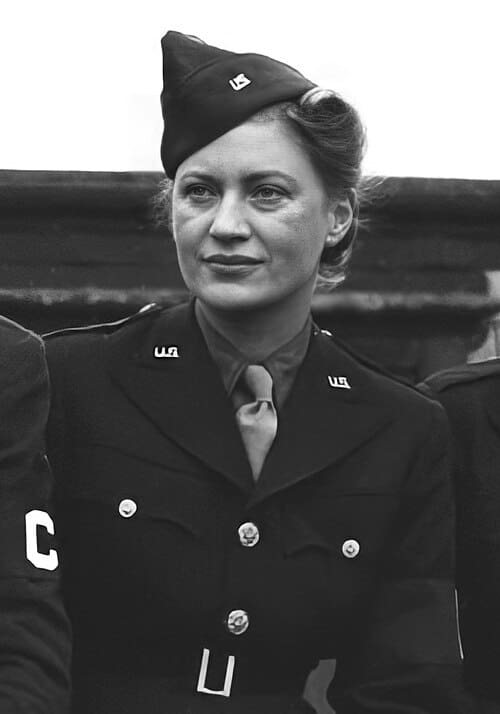
“Curiously enough, at an auction she bought a table that had belonged to my family. It was known that Lee had sat around at the table, done probably a lot of drinking, a lot of talking and quite a lot of cooking. Kate felt some sort of an affinity to that table, that it connected her to Lee in some way, that was when she really got going on the idea of making it,” he adds.
Penrose recalls being sat alongside Winslet in a Soho cinema as he watched the final cut of Lee for the first time, absorbing her uncanny performance as his late mother.
“It was deeply moving, and then devastating,” he says.
“We were sitting there in this small cinema, me Kate (Winslet) and Kate Solomon the producer, just us. I was completely unprepared for the sitting room sequence where she’s sitting there puffing away on a cigarette, pouring another gin, I just thought ‘Christ, it’s her!’,” Penrose says.
“How did they do that? She’s been dead for years, it can’t be her. No it’s Kate dressed up, no it’s Lee. It’s for real. There was a dissonance crashing around inside my head and it was overwhelming, I really thought it was my mum, my dead mum, come back to life, enjoying a gin and a fag,” he adds.
The type of scenes Antony describes are scattered throughout the film, where Winslet playing an older Lee Miller sits across from Josh O’Connor, who we’re led to believe is playing a journalist probing for insight into her experiences of the war.
In a twist at the film’s conclusion, Josh O’Connor’s supposed reporter is actually revealed to be playing Penrose himself, showing an imagined interaction between the mother and son that never took place.
“So Josh O’Connor, pretending to be me, was sitting there asking all the questions that I had wanted to ask, but couldn’t ask. I had to find ways of getting answers for them, and this was a poignant way of recognising she’d gone,” Penrose says.
He describes the cathartic experience of watching the scenes imagining the conversations between himself and his mother unfold.
“I loved it, because I was envious, those were the questions I myself would have loved to have posed to her in her lifetime,” he says.
“It was a tremendous emotional ride, and I just thought it was so beautifully handled. That sense of regret as it pans over the photographs and you realise the chairs empty, and she’s not there,” he adds.
One of the most poignant scenes in Lee, and one of the most seminal moments of Miller’s time photographing the war, was the discovery of the Dachau and Buchenwald concentration camps.
“She recognised that as a photographer she had the ability to share the witnessing of these events. She was using the camera as a storytelling device, to tell everybody back home what was going on, that was terribly important to her,” Penrose says.
“So when she gets to Dachau or Buchenwald, she makes sure that everybody knows what has happened. She’s grabbing us, banging our faces into it and saying, ‘look what’s been allowed to happen, see this and never allow it to happen again’,” he adds.
He describes gaining an insight into his mothers experiences, through hundreds of hours of conversations with David E. Scherman, Lee’s fellow photographer played by Andy Samberg in the film, who Penrose describes as “one of the most important people in my life”.
“Scherman told me she went around in an ice cold rage, she was so furious that, despite the hazards, the horror, she wanted to make damn sure she got really good pictures to show the world,” Penrose says.
While American Vogue ran a number of Miller’s most harrowing pictures, paired simply with the headline “believe it”, prompted by a telegram she sent back containing the words “I implore you to believe this is true”, as shown in Lee, Vogue UK held back from publishing the photographs she took at the death camps.
Penrose mentions the scene where Winslet’s Lee Miller arrives at the Vogue offices after this realisation sets in, furious her pictures had been left out.
“The way she forced herself to photograph Dachau, she was so angry when Vogue didn’t publish the holocaust sequence.
“There was the amazing scene with Audrey Withers (editor-in-chief at Vogue), you begin to realise how deeply held that passion was. She wanted Britain to see what had happened,” Penrose says.
One of extremely few female frontline correspondents during the Second World War, Penrose calls her “practically unique” in this sense.
“As far as we know, Lee was the only female photographer within the infantry. You’ve got to move with them, she had to make do and survive on her wits. There was one point in Alsace when she was pinned down by enemy fire for three days and couldn’t move. If you’re a photographer, you have to be there to get the picture,” he says.
“Today there are a large number of very distinguished female photographers who have made a huge contribution to our understanding of conflict. But at that point, it was Lee and her Rolleiflex and that was it,” he adds.
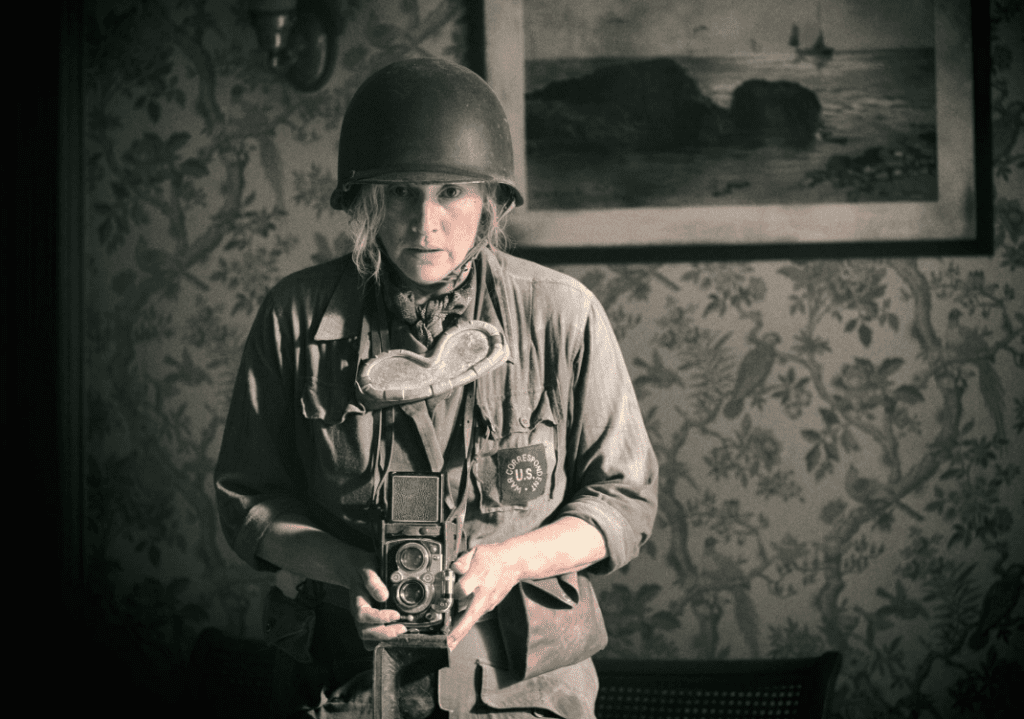
Penrose recalls giving Winslet a crash course in using the notoriously difficult Rolleiflex, Lee Miller’s camera of choice throughout the war.
“It’s quite a difficult camera to use. But Lee became so fluent with it, she used it to perfection. Kate learned to use it within the space of about two weeks. She found an incredible camera technician, and he got about four or five broken cameras and made one that really worked, the same vintage and same configuration as Lee’s,” he says.
“She said, ‘I don’t want it to just be a prop’, she insisted on learning how to use it, how to load it, how to light meter and focus. I gave her a fairly intensive teaching, I must say she’s one of those people that learns bloody fast!
“It gives that sense of authenticity, the camera itself was featured quite a lot in the film, so it becomes a fellow witness, a personality, and I thought that was really justified,” he says
Nailing down Miller’s identical Rolleiflex camera is just one example of the film’s endeavour to remain as true as possible to Lee Miller’s life story, which is something that was key to Penrose from the outset.
“We had a screenwriter, Marion Hume, who absolutely agreed with me, she wanted it to be as accurate as possible. It has not drawn one single adverse comment from the military historians at all,” he says.
Penrose calls the screenwriter “almost obsessive” in wanting not to stray from the truth, through insisting that Penrose accompany her to a visit to Dachau to view their archives, to chancing their way into Hitler’s apartment that’s now closed off to the public.
“Going to Hitler’s apartment in Munich, that’s damn difficult to get into. Luckily, I had a historian friend who got us in there. We were able to see the layout of the apartment and compare it to the photographs. It was a meticulous attention to detail, so when you see it in the movie it’s authentic, that’s how it really was,” Penrose says.
The photographs he refers to taken in Hitler’s Munich apartment are some of Lee Miller’s most enduring, namely, where she’s photographed by Scherman taking a bath, her boots sat on the mat in the foreground covered in dirt and ash from her visit to Dachau hours before, with a framed portrait of Hitler placed knowingly in the background.
Seeing his mother’s life story, the side of which he never knew whilst she was alive, put to screen allowed Penrose to gain a new perspective of what she went through.
“I kind of knew it and could empathize myself into it, but one of the things I’ve never been is a woman. This was why it was so fascinating working with Kate and Marion, particularly with Kate, I began to understand what she had achieved, from a woman’s point of view, that put a different aspect into it and was probably one of the most important things I got out of it,” he says.
He lists the key driving forces behind the film, Director Ellen Kuras, Kate Winslet, Producer Kate Solomon and Screenwriters Marion Hume and Liz Hannah.
“It has authenticity, it has depth, and what I think the absolutely key thing about it is, it’s a film about a woman, made by women,” he says.
“Here was this incredible woman, who against all the odds, temporal, social, military, she achieved. It was just her determination and talent, and her ability to carry it forwards. I find she is the spirit of liberation.
“Lee was a bit of a puzzle, she was this American who didn’t behave the same way as anyone else, that allowed her to break down a lot of barriers, she never set out to be conventional,” he says.
“She just instinctively followed the action, wherever it was,” Penrose adds.
He agrees that the process of bringing his mother’s story to life has brought him closer to the person he never knew.
“I was able to see things through her eyes, thanks to Kate and working so closely with her, and that for me was an incredibly wonderful gift,” he says.